Statutory sanction for delayed reassessment requires approval from the prescribed authority; approval by an inferior authority invalidates jurisdictio...
Transfer pricing margin adjustments require matching treatment of non-operating income and related costs, with comparability issues reconsidered on ev...
Preliminary-expense amortisation and MAT exempt-income adjustments prevailed, while trademark costs and managerial remuneration require fresh verifica...
Export valuation requires contemporaneous evidence; unrelated invoices cannot prove overvaluation, and dual penalties on firm and partner are impermis...
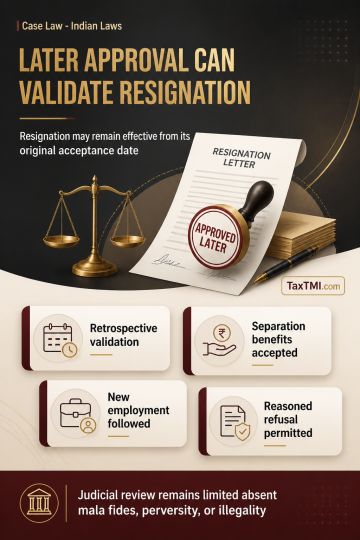
Ratification of resignation acceptance validates separation retrospectively, while withdrawal may be refused through reasoned administrative discretio...
Nature-dependent electricity contracts receive new Ind AS accounting, hedge designation, transition and financial-statement disclosure requirements fr...
In real estate insolvency, where the Section 7 applicants were allottees of one project and the alleged default related only to that project, the NCLAT held that the CIRP should proceed on a project-specific basis. The admission order was modified to confine the insolvency process to Krishna Housing Scheme, since extending it to other projects would prejudice separate homebuyers and stakeholders. The Tribunal further held that claims in the CIRP must also be limited to that project, while the IRP/RP may process claims under the CIRP Regulations and need not adjudicate individual creditor disputes at this stage. Creditors and financial institutions linked to other projects were left free to pursue independent remedies.
In real estate insolvency, where the Section 7 applicants were allottees of one project and the alleged default related only to that project, the NCLAT held that the CIRP should proceed on a project-specific basis. The admission order was modified to confine the insolvency process to Krishna Housing Scheme, since extending it to other projects would prejudice separate homebuyers and stakeholders. The Tribunal further held that claims in the CIRP must also be limited to that project, while the IRP/RP may process claims under the CIRP Regulations and need not adjudicate individual creditor disputes at this stage. Creditors and financial institutions linked to other projects were left free to pursue independent remedies.
Note: It is a system-generated summary and is for quick reference only.
 TaxTMI
  TaxTMI
 of 4826
















 Join Channel