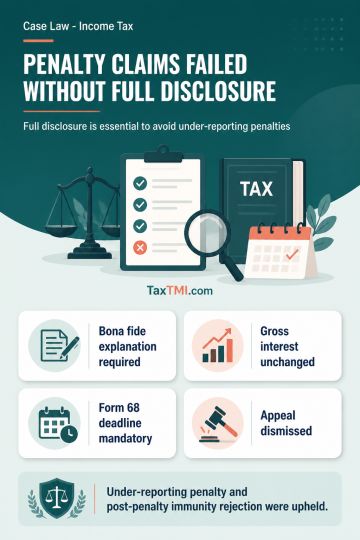
Bona fide disclosure requirements govern under-reporting penalties, and post-penalty immunity applications cannot secure available statutory protectio...
Certificate-of-origin verification procedure governs preferential customs benefits; denial without retroactive verification was set aside with consequ...
Disciplinary Committee jurisdiction and mandatory investigation requirements invalidated cancellation of an insolvency professional's registration and...
Retention of seized property survives where recorded reasons support proceeds of crime, while stayed investigation periods are excluded from limitatio...
Specified income of Baddi Barotiwala Nalagarh Development Authority receives conditional tax exemption, retrospectively covering its designated assess...
Page of 4816
Press 'Enter' after typing page number.
1461 to 1480 of 96301 Results
❮
❯
❯❯
0 / 200
Expand Note
Add to Folder
No Folders have been created
+
Are you sure you want to delete "My most important" ?
Writ jurisdiction under Article 226 was declined against a show cause notice and consequential order under section 74 of the CGST Act because an efficacious statutory appeal was available under section 107 read with Rule 109A. The Court held that challenges requiring examination of the corrigendum, the underlying material, and the nature of the correction involved factual appreciation and therefore did not fall within the limited certiorari jurisdiction. Mere disagreement with the adjudicating authority's conclusions was insufficient to bypass the appellate remedy. The Court also noted that recognised exceptional grounds such as breach of fundamental rights, natural justice violations, excess of jurisdiction, or challenge to vires were not made out on the material before it, and it expressed no opinion on the merits.
Writ jurisdiction under Article 226 was declined against a show cause notice and consequential order under section 74 of the CGST Act because an efficacious statutory appeal was available under section 107 read with Rule 109A. The Court held that challenges requiring examination of the corrigendum, the underlying material, and the nature of the correction involved factual appreciation and therefore did not fall within the limited certiorari jurisdiction. Mere disagreement with the adjudicating authority's conclusions was insufficient to bypass the appellate remedy. The Court also noted that recognised exceptional grounds such as breach of fundamental rights, natural justice violations, excess of jurisdiction, or challenge to vires were not made out on the material before it, and it expressed no opinion on the merits.
Note: It is a system-generated summary and is for quick reference only.
 TaxTMI
  TaxTMI
 of 4816





















 Join Channel