Transfer pricing and tax deductions upheld on established principles, while employee contributions and warranty provisions returned for fresh examinat...
Captive transfer pricing relies on industrial consumer tariffs, while genuine quotations can benchmark effluent treatment transfers under the Other Me...
Specific tariff classification for ophthalmic instruments and extended limitation principles determine the treatment of duty demands, confiscation, an...
Integrated golf function determines classification, placing launch monitors and simulators under other golf equipment rather than measuring instrument...
Public servant status under anti-corruption law extends to recognised stock exchange leadership; constitutional and sanction challenges do not succeed...
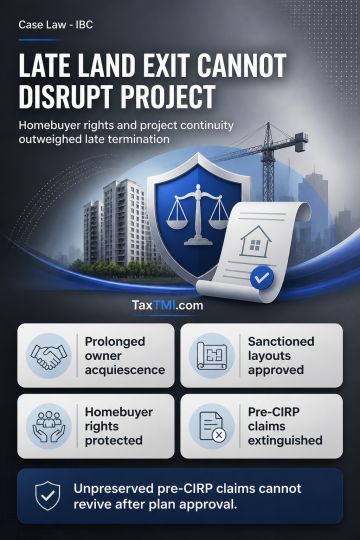
Acquiescence, homebuyer protection and clean-slate resolution principles prevent landowners from disrupting an integrated project through late termina...
Page of 4817
Press 'Enter' after typing page number.
1501 to 1520 of 96333 Results
❮
❯
❯❯
0 / 200
Expand Note
Add to Folder
No Folders have been created
+
Are you sure you want to delete "My most important" ?
IBC's overriding effect was held to displace inconsistent contractual or prior statutory claims, and the approved resolution plan was binding on all stakeholders, including shareholders and the State. A shareholder of the corporate debtor had no independent right in project or leasehold assets, so dilution of that interest under the CIRP was a statutory insolvency consequence, not a violation of Article 300A. The Court also rejected Article 14 and plan-modification objections, holding that retention of the operator fell within commercial discretion and supported going-concern continuity. Fresh tender and FDI-based challenges were declined as matters within the insolvency framework and regulatory domain. Re-litigation was treated as abuse of process, and costs were upheld.
IBC's overriding effect was held to displace inconsistent contractual or prior statutory claims, and the approved resolution plan was binding on all stakeholders, including shareholders and the State. A shareholder of the corporate debtor had no independent right in project or leasehold assets, so dilution of that interest under the CIRP was a statutory insolvency consequence, not a violation of Article 300A. The Court also rejected Article 14 and plan-modification objections, holding that retention of the operator fell within commercial discretion and supported going-concern continuity. Fresh tender and FDI-based challenges were declined as matters within the insolvency framework and regulatory domain. Re-litigation was treated as abuse of process, and costs were upheld.
Note: It is a system-generated summary and is for quick reference only.
 TaxTMI
  TaxTMI
 of 4817




















 Join Channel