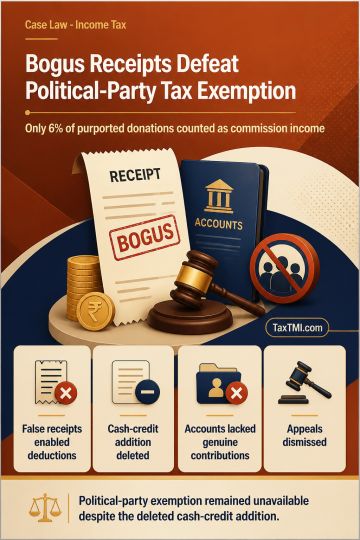
Food supplement classification requires common parlance and authoritative tests, preventing treatment as proprietary Ayurvedic medicines without suppo...
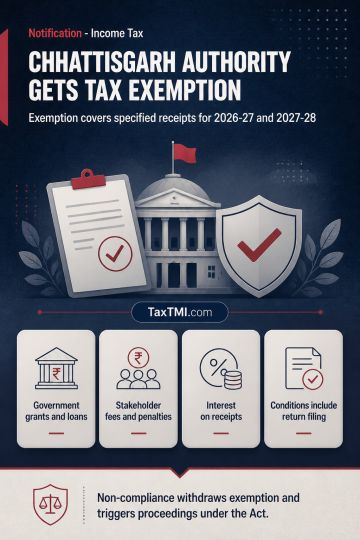
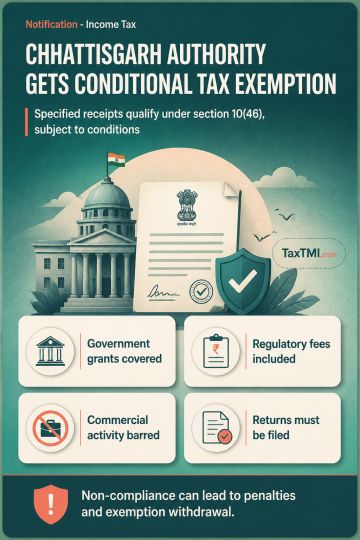
Specified regulatory authority income receives conditional tax exemption, subject to non-commercial activity, unchanged income character, and return f...
Tax exemption for regulatory authority income applies retrospectively, subject to non-commercial activity, unchanged income sources, and return-filing...
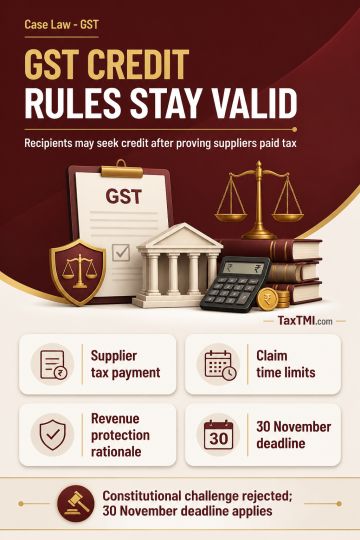
Input tax credit conditions remain constitutionally valid, with eligible recipient claims considered under GST circulars and retrospective filing dead...
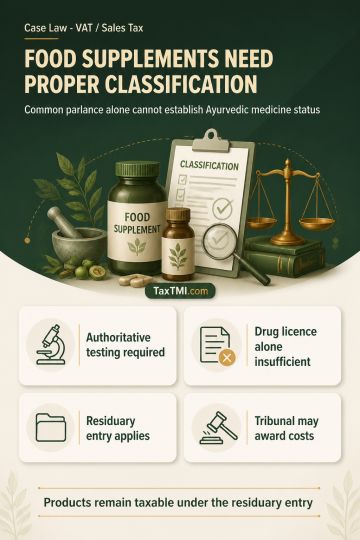
Bogus donation receipts justified commission income assessment and defeated political-party tax exemption for inaccurate accounts and reporting failur...
Page of 4821
Press 'Enter' after typing page number.
1101 to 1120 of 96408 Results
❮
❯
❯❯
0 / 200
Expand Note
Add to Folder
No Folders have been created
+
Are you sure you want to delete "My most important" ?
IBC's overriding effect was held to displace inconsistent contractual or prior statutory claims, and the approved resolution plan was binding on all stakeholders, including shareholders and the State. A shareholder of the corporate debtor had no independent right in project or leasehold assets, so dilution of that interest under the CIRP was a statutory insolvency consequence, not a violation of Article 300A. The Court also rejected Article 14 and plan-modification objections, holding that retention of the operator fell within commercial discretion and supported going-concern continuity. Fresh tender and FDI-based challenges were declined as matters within the insolvency framework and regulatory domain. Re-litigation was treated as abuse of process, and costs were upheld.
IBC's overriding effect was held to displace inconsistent contractual or prior statutory claims, and the approved resolution plan was binding on all stakeholders, including shareholders and the State. A shareholder of the corporate debtor had no independent right in project or leasehold assets, so dilution of that interest under the CIRP was a statutory insolvency consequence, not a violation of Article 300A. The Court also rejected Article 14 and plan-modification objections, holding that retention of the operator fell within commercial discretion and supported going-concern continuity. Fresh tender and FDI-based challenges were declined as matters within the insolvency framework and regulatory domain. Re-litigation was treated as abuse of process, and costs were upheld.
Note: It is a system-generated summary and is for quick reference only.
 TaxTMI
  TaxTMI
 of 4821









 Join Channel