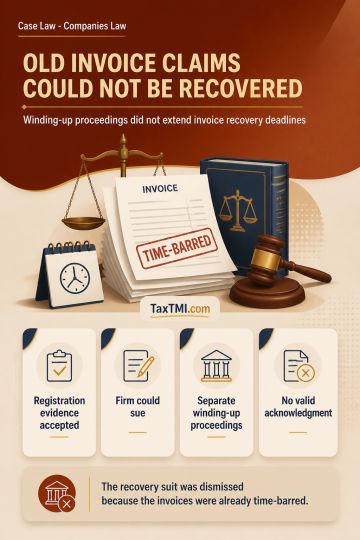
Invoice-based recovery claims remain time-barred despite separate winding-up proceedings, absent valid acknowledgment or part-payment of the disputed ...
Extended limitation fails without specific suppression allegations, while overseas employee secondment remains taxable as manpower supply within norma...
Time-share accommodation classification excludes Club or Association Service where purchasers receive contractual occupancy rights without genuine mem...
CENVAT credit for trading requires reversal, while taxable-service rental credit remains proportionately available and limitation issues await resolut...
Vicarious liability for dishonoured company cheques may extend to non-signatory directors where complaints contain foundational responsibility avermen...
IBC's overriding effect was held to displace inconsistent contractual or prior statutory claims, and the approved resolution plan was binding on all stakeholders, including shareholders and the State. A shareholder of the corporate debtor had no independent right in project or leasehold assets, so dilution of that interest under the CIRP was a statutory insolvency consequence, not a violation of Article 300A. The Court also rejected Article 14 and plan-modification objections, holding that retention of the operator fell within commercial discretion and supported going-concern continuity. Fresh tender and FDI-based challenges were declined as matters within the insolvency framework and regulatory domain. Re-litigation was treated as abuse of process, and costs were upheld.
IBC's overriding effect was held to displace inconsistent contractual or prior statutory claims, and the approved resolution plan was binding on all stakeholders, including shareholders and the State. A shareholder of the corporate debtor had no independent right in project or leasehold assets, so dilution of that interest under the CIRP was a statutory insolvency consequence, not a violation of Article 300A. The Court also rejected Article 14 and plan-modification objections, holding that retention of the operator fell within commercial discretion and supported going-concern continuity. Fresh tender and FDI-based challenges were declined as matters within the insolvency framework and regulatory domain. Re-litigation was treated as abuse of process, and costs were upheld.
Note: It is a system-generated summary and is for quick reference only.
 TaxTMI
  TaxTMI
 of 4826














 Join Channel