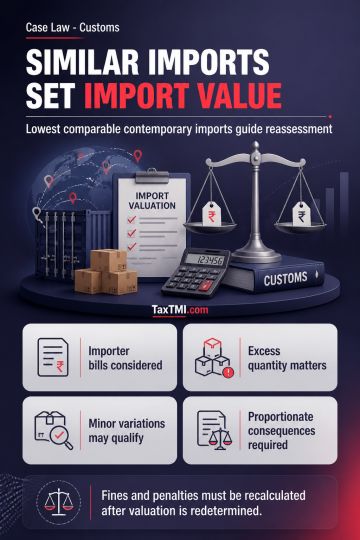
Customs valuation must use comparable contemporary imports, while confiscation fines and penalties require proportionate recalculation on reassessed v...
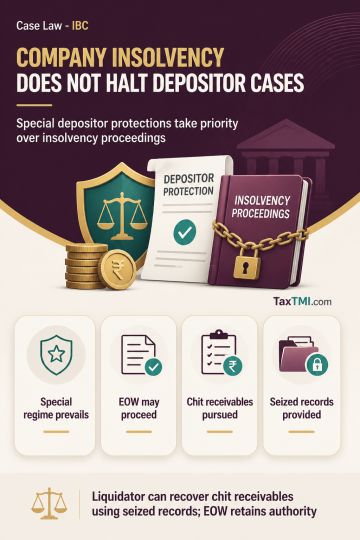
Depositor-protection proceedings prevail over corporate insolvency, while liquidators may recover chit receivables using copies of seized company reco...
Intermediary service classification fails where overseas admission facilitation is supplied independently, preserving export treatment and small-provi...
Satellite transponder bandwidth is telecommunication, not Business Support Service; foreign non-telegraph providers triggered no service tax liability...
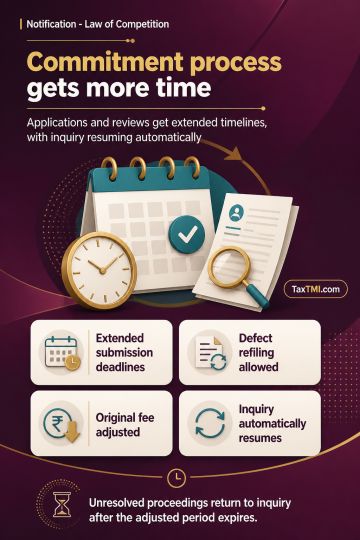
Commitment proceedings gain extended timelines, structured defect refiling, and automatic resumption of inquiry after the adjusted completion period e...
IBC's overriding effect was held to displace inconsistent contractual or prior statutory claims, and the approved resolution plan was binding on all stakeholders, including shareholders and the State. A shareholder of the corporate debtor had no independent right in project or leasehold assets, so dilution of that interest under the CIRP was a statutory insolvency consequence, not a violation of Article 300A. The Court also rejected Article 14 and plan-modification objections, holding that retention of the operator fell within commercial discretion and supported going-concern continuity. Fresh tender and FDI-based challenges were declined as matters within the insolvency framework and regulatory domain. Re-litigation was treated as abuse of process, and costs were upheld.
IBC's overriding effect was held to displace inconsistent contractual or prior statutory claims, and the approved resolution plan was binding on all stakeholders, including shareholders and the State. A shareholder of the corporate debtor had no independent right in project or leasehold assets, so dilution of that interest under the CIRP was a statutory insolvency consequence, not a violation of Article 300A. The Court also rejected Article 14 and plan-modification objections, holding that retention of the operator fell within commercial discretion and supported going-concern continuity. Fresh tender and FDI-based challenges were declined as matters within the insolvency framework and regulatory domain. Re-litigation was treated as abuse of process, and costs were upheld.
Note: It is a system-generated summary and is for quick reference only.
 TaxTMI
  TaxTMI
 of 4828











 Join Channel