Business expenditure deduction requires proof of genuine commission payments and commercial allowability; turnover growth alone cannot validate the cl...
Article 8 treaty coverage excluded third-party airline support services, while documented demonetisation cash receipts remained accepted business inco...
Functional comparability under TNMM requires highway contract benchmarks to reflect operation, maintenance and transfer activities, requiring fresh be...
Objective characteristics govern magnesium bis-glycinate chelate classification as an amino-acid coordination compound, not a food preparation or anti...
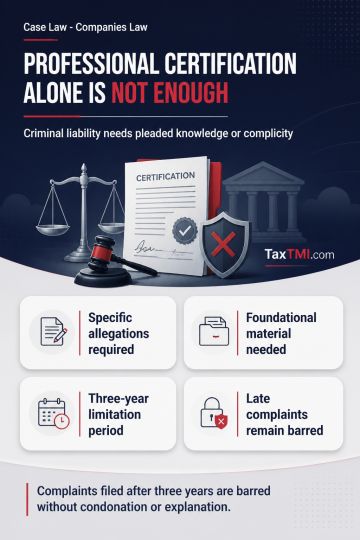
Independent professional certification requires pleaded knowledge or complicity for criminal liability; untimely complaints remain barred by limitatio...
Bid-rigging was proved by direct and circumstantial email evidence showing coordinated bidding, allocation of shares, tender distribution, price discussions, bid withdrawal directions and continued receipt of cartel communications without dissociation; contravention under Sections 3(1) and 3(3)(a) to (d) was therefore affirmed. Once cartel conduct was established, the presumption of appreciable adverse effect on competition applied and was not rebutted; reliance on Rajasthan Cylinder was distinguished. The partner's liability under Section 48 was upheld, and penalty based on average income at the same rate as the firm was held proper. Challenges based on vacancy in composition and denial of cross-examination failed, and both appeals were dismissed.
Bid-rigging was proved by direct and circumstantial email evidence showing coordinated bidding, allocation of shares, tender distribution, price discussions, bid withdrawal directions and continued receipt of cartel communications without dissociation; contravention under Sections 3(1) and 3(3)(a) to (d) was therefore affirmed. Once cartel conduct was established, the presumption of appreciable adverse effect on competition applied and was not rebutted; reliance on Rajasthan Cylinder was distinguished. The partner's liability under Section 48 was upheld, and penalty based on average income at the same rate as the firm was held proper. Challenges based on vacancy in composition and denial of cross-examination failed, and both appeals were dismissed.
Note: It is a system-generated summary and is for quick reference only.
 TaxTMI
  TaxTMI
 of 4824
















 Join Channel