Exempt-income expenditure disallowance is confined to investments that actually generated exempt income, while supported business expenses remain dedu...
Objective characteristics and principal use govern mining-tyre classification, while fresh advance ruling applications may rely on additional technica...
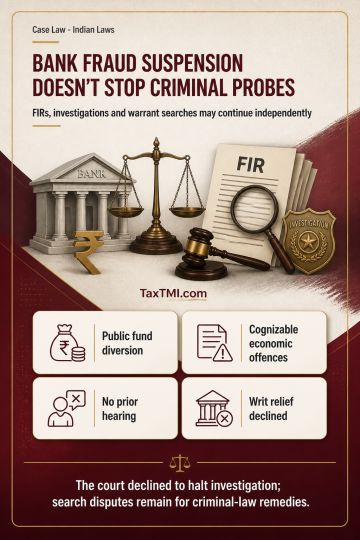
Administrative fraud classification suspension does not halt independent criminal investigation or warrant-based searches into alleged economic offenc...
Clause 10(e) of the CBDT circulars was interpreted as illustrative, not exhaustive, for identifying law enforcement agencies. The High Court held that DGCEI, being an enforcement agency, falls within that expression and could not be excluded merely because it was not named alongside CBI, ED, DRI, SFIO and DGGI. The Tribunal had therefore misread the circulars in rejecting the Revenue's rectification application under section 254(2), and that rejection could not stand. The impugned order was set aside, the rectification matter was restored to the Tribunal, and the issue was remanded for fresh decision after hearing both sides.
Clause 10(e) of the CBDT circulars was interpreted as illustrative, not exhaustive, for identifying law enforcement agencies. The High Court held that DGCEI, being an enforcement agency, falls within that expression and could not be excluded merely because it was not named alongside CBI, ED, DRI, SFIO and DGGI. The Tribunal had therefore misread the circulars in rejecting the Revenue's rectification application under section 254(2), and that rejection could not stand. The impugned order was set aside, the rectification matter was restored to the Tribunal, and the issue was remanded for fresh decision after hearing both sides.
Note: It is a system-generated summary and is for quick reference only.
 TaxTMI
  TaxTMI
 of 4824


















 Join Channel


