Patent-settlement expenditure treated as commercially expedient revenue outlay, with foreign-law restrictions inapplicable before the prospective amen...
International transaction benchmarking restricts transfer pricing adjustments to associated-enterprise dealings, while functional comparability govern...
Joint development agreements defer taxable transfer where possession lacks part performance, while completed flats determine consideration and exempti...
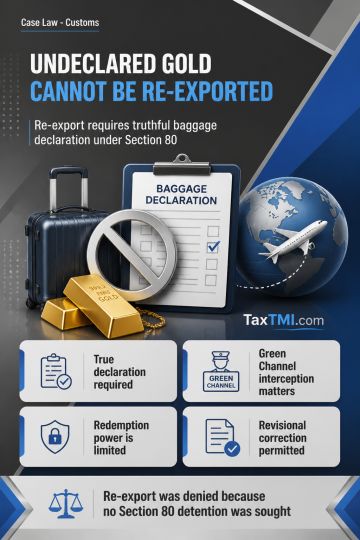
Passenger baggage re-export requires true declaration and cannot be granted indirectly through discretionary redemption of undeclared prohibited goods...
Page of 4821
Press 'Enter' after typing page number.
861 to 880 of 96406 Results
❮
❯
❯❯
0 / 200
Expand Note
Add to Folder
No Folders have been created
+
Are you sure you want to delete "My most important" ?
Section 3(2) of the Foreign Trade (Development and Regulation) Act, 1992 empowers the Central Government to prohibit, restrict or otherwise regulate imports by Gazette order, and section 5 permits amendment of foreign trade policy. On that basis, a notification fixing a Minimum Import Price for roasted areca nut was within statutory competence. The notification was also treated as consistent with the ASEAN and WTO framework because it operated as a non-tariff safeguard for agricultural products, fixed only a trigger price, and did not impose a quantitative import cap. Importers could not avoid the MIP condition by relying on nil-duty eligibility under Notification No. 46/2011.
Section 3(2) of the Foreign Trade (Development and Regulation) Act, 1992 empowers the Central Government to prohibit, restrict or otherwise regulate imports by Gazette order, and section 5 permits amendment of foreign trade policy. On that basis, a notification fixing a Minimum Import Price for roasted areca nut was within statutory competence. The notification was also treated as consistent with the ASEAN and WTO framework because it operated as a non-tariff safeguard for agricultural products, fixed only a trigger price, and did not impose a quantitative import cap. Importers could not avoid the MIP condition by relying on nil-duty eligibility under Notification No. 46/2011.
Note: It is a system-generated summary and is for quick reference only.
 TaxTMI
  TaxTMI
 of 4821
















 Join Channel