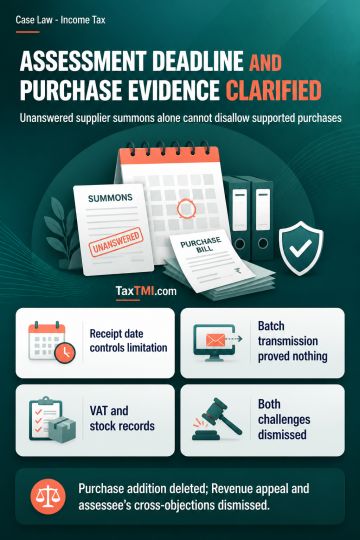
Limitation for consequential assessments runs from prescribed authority receipt, while verified purchases cannot be disallowed merely for unanswered s...
Higher depreciation for qualifying commercial vehicles, exempt-income disallowance, research deduction verification, and club-expense treatment clarif...
Charitable registration renewal cannot become an assessment of receipts, profitability or annual exemption compliance, requiring renewal and donation ...
AMP expenditure for own business is not an international transaction without an associated-enterprise arrangement, eliminating transfer pricing adjust...
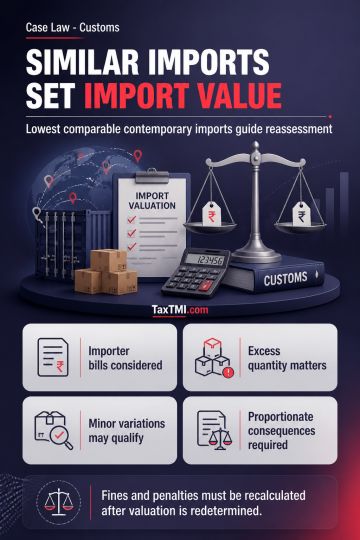
Customs valuation must use comparable contemporary imports, while confiscation fines and penalties require proportionate recalculation on reassessed v...
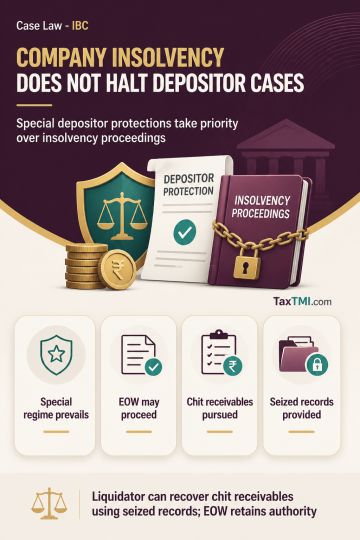
Depositor-protection proceedings prevail over corporate insolvency, while liquidators may recover chit receivables using copies of seized company reco...
Page of 4826
Press 'Enter' after typing page number.
481 to 500 of 96509 Results
❮
❯
❯❯
0 / 200
Expand Note
Add to Folder
No Folders have been created
+
Are you sure you want to delete "My most important" ?
Section 3(2) of the Foreign Trade (Development and Regulation) Act, 1992 empowers the Central Government to prohibit, restrict or otherwise regulate imports by Gazette order, and section 5 permits amendment of foreign trade policy. On that basis, a notification fixing a Minimum Import Price for roasted areca nut was within statutory competence. The notification was also treated as consistent with the ASEAN and WTO framework because it operated as a non-tariff safeguard for agricultural products, fixed only a trigger price, and did not impose a quantitative import cap. Importers could not avoid the MIP condition by relying on nil-duty eligibility under Notification No. 46/2011.
Section 3(2) of the Foreign Trade (Development and Regulation) Act, 1992 empowers the Central Government to prohibit, restrict or otherwise regulate imports by Gazette order, and section 5 permits amendment of foreign trade policy. On that basis, a notification fixing a Minimum Import Price for roasted areca nut was within statutory competence. The notification was also treated as consistent with the ASEAN and WTO framework because it operated as a non-tariff safeguard for agricultural products, fixed only a trigger price, and did not impose a quantitative import cap. Importers could not avoid the MIP condition by relying on nil-duty eligibility under Notification No. 46/2011.
Note: It is a system-generated summary and is for quick reference only.
 TaxTMI
  TaxTMI
 of 4826



















 Join Channel