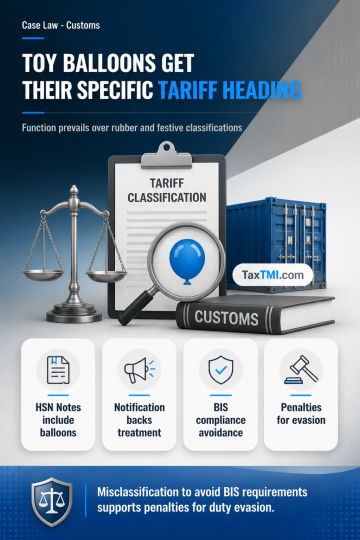
Toy balloon tariff classification: functional heading prevails over residual rubber and festive article headings, supporting penalties for deliberate ...
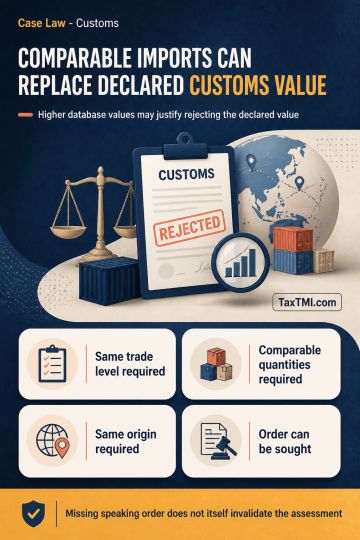
Customs valuation using comparable contemporaneous imports can displace declared value, while missing speaking orders require pursuit before competent...
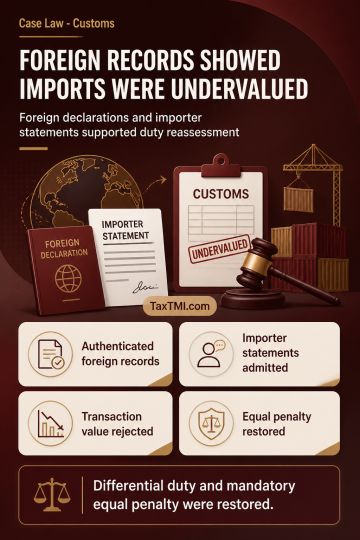
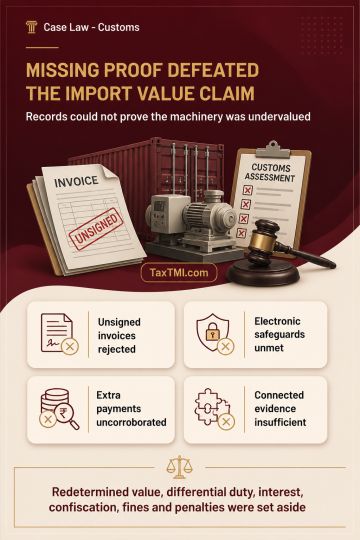
Foreign customs declarations and importer admissions established undervaluation, supporting sequential value redetermination, differential duty, and m...
Customs seizure safeguards prevent detention-based limitation avoidance and invalidate provisional release conditions for imported vehicles under an i...
Page of 4827
Press 'Enter' after typing page number.
341 to 360 of 96536 Results
❮
❯
❯❯
0 / 200
Expand Note
Add to Folder
No Folders have been created
+
Are you sure you want to delete "My most important" ?
Section 3(2) of the Foreign Trade (Development and Regulation) Act, 1992 empowers the Central Government to prohibit, restrict or otherwise regulate imports by Gazette order, and section 5 permits amendment of foreign trade policy. On that basis, a notification fixing a Minimum Import Price for roasted areca nut was within statutory competence. The notification was also treated as consistent with the ASEAN and WTO framework because it operated as a non-tariff safeguard for agricultural products, fixed only a trigger price, and did not impose a quantitative import cap. Importers could not avoid the MIP condition by relying on nil-duty eligibility under Notification No. 46/2011.
Section 3(2) of the Foreign Trade (Development and Regulation) Act, 1992 empowers the Central Government to prohibit, restrict or otherwise regulate imports by Gazette order, and section 5 permits amendment of foreign trade policy. On that basis, a notification fixing a Minimum Import Price for roasted areca nut was within statutory competence. The notification was also treated as consistent with the ASEAN and WTO framework because it operated as a non-tariff safeguard for agricultural products, fixed only a trigger price, and did not impose a quantitative import cap. Importers could not avoid the MIP condition by relying on nil-duty eligibility under Notification No. 46/2011.
Note: It is a system-generated summary and is for quick reference only.
 TaxTMI
  TaxTMI
 of 4827












 Join Channel