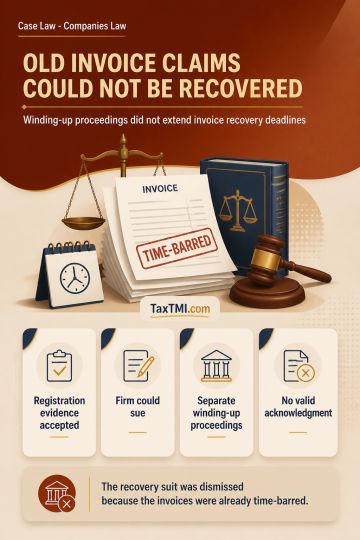
Invoice-based recovery claims remain time-barred despite separate winding-up proceedings, absent valid acknowledgment or part-payment of the disputed ...
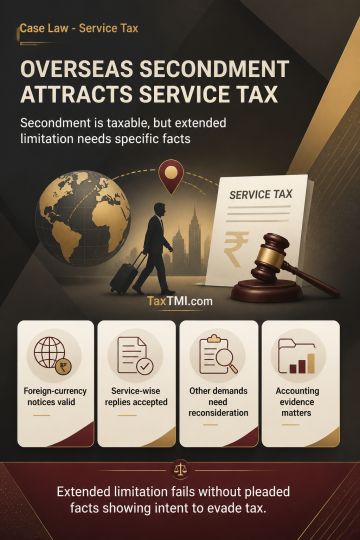
Extended limitation fails without specific suppression allegations, while overseas employee secondment remains taxable as manpower supply within norma...
Time-share accommodation classification excludes Club or Association Service where purchasers receive contractual occupancy rights without genuine mem...
CENVAT credit for trading requires reversal, while taxable-service rental credit remains proportionately available and limitation issues await resolut...
Page of 4792
Press 'Enter' after typing page number.
61 to 80 of 95833 Results
❮
❯
❯❯
0 / 200
Expand Note
Add to Folder
No Folders have been created
+
Are you sure you want to delete "My most important" ?
A Section 9 IBC application cannot be admitted where the record shows a genuine and plausible pre-existing dispute before the demand notice. Applying Mobilox and later decisions, the Court held that the adjudicating authority at this stage only examines whether a plausible contention requiring investigation exists, not the ultimate merits of the dispute. Written complaints about defective supplies, repeated demands for reconciliation of accounts, a prior police complaint, discrepancies in ledger accounts, and shifting stands on the amount due showed no consensus on liability or quantum and indicated more than a sham defence. The NCLT had correctly rejected the application, and the NCLAT was wrong to reverse that finding.
A Section 9 IBC application cannot be admitted where the record shows a genuine and plausible pre-existing dispute before the demand notice. Applying Mobilox and later decisions, the Court held that the adjudicating authority at this stage only examines whether a plausible contention requiring investigation exists, not the ultimate merits of the dispute. Written complaints about defective supplies, repeated demands for reconciliation of accounts, a prior police complaint, discrepancies in ledger accounts, and shifting stands on the amount due showed no consensus on liability or quantum and indicated more than a sham defence. The NCLT had correctly rejected the application, and the NCLAT was wrong to reverse that finding.
Note: It is a system-generated summary and is for quick reference only.
 TaxTMI
 of 4792










 Join Channel


 TaxTMI

