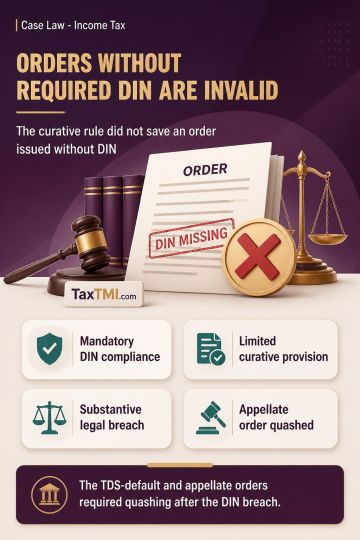
Document Identification Number compliance renders TDS-default orders invalid where mandatory DIN requirements are breached and curative provision does...
ITAT held that, in a best judgment assessment for gross profit estimation, the assessee's earlier year on identical facts provided the proper benchmark. The ad hoc estimation of income at 2 per cent of turnover was rejected because no distinguishing feature was shown, and income was directed to be computed at 0.40 per cent of gross sales. On the penalty issue, the Tribunal held that once substantial relief was granted in quantum and the basis of estimation was substituted, the foundation for penalty for inaccurate particulars did not survive. The penalty was therefore deleted.
ITAT held that, in a best judgment assessment for gross profit estimation, the assessee's earlier year on identical facts provided the proper benchmark. The ad hoc estimation of income at 2 per cent of turnover was rejected because no distinguishing feature was shown, and income was directed to be computed at 0.40 per cent of gross sales. On the penalty issue, the Tribunal held that once substantial relief was granted in quantum and the basis of estimation was substituted, the foundation for penalty for inaccurate particulars did not survive. The penalty was therefore deleted.
Note: It is a system-generated summary and is for quick reference only.
 TaxTMI
  TaxTMI
 of 4918