Inherited property sale proceeds require capital-gains treatment where ownership is supported by evidence, not suspicion or unverified signature doubt...
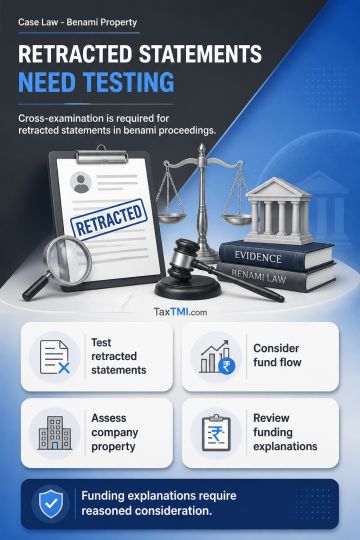
Cross-examination of retracted statements is essential where foundational evidence supports a benami allegation and documented funding explanations re...
Capital-goods exemption covers plant-modernisation accessories, while the import restriction applies only to earlier capital-goods components and spar...
Constitutional judicial review permits challenges to ECIRs and connected money-laundering proceedings where coercive action affects fundamental intere...
Penalty under section 271D was unsustainable because the Tribunal found that the impugned receipts were made through banking channels by cheque on the dates shown, and the lower authorities had proceeded on an incorrect assumption about the transaction year; once cheque receipts were established, no contravention of section 269SS survived. Penalty under section 271(1)(c) was also not leviable because the loss claim was based on audited accounts and related business expenditure, and mere acceptance of disallowance did not amount to furnishing inaccurate particulars. Applying Reliance Petro Products, the Tribunal deleted both penalties.
Penalty under section 271D was unsustainable because the Tribunal found that the impugned receipts were made through banking channels by cheque on the dates shown, and the lower authorities had proceeded on an incorrect assumption about the transaction year; once cheque receipts were established, no contravention of section 269SS survived. Penalty under section 271(1)(c) was also not leviable because the loss claim was based on audited accounts and related business expenditure, and mere acceptance of disallowance did not amount to furnishing inaccurate particulars. Applying Reliance Petro Products, the Tribunal deleted both penalties.
Note: It is a system-generated summary and is for quick reference only.
 TaxTMI
 of 4805
















 Join Channel


 TaxTMI