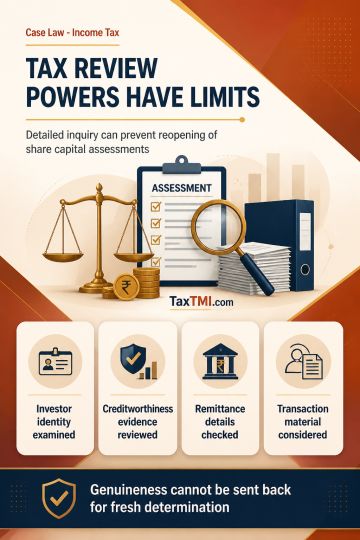
Revisionary jurisdiction cannot reopen share capital assessments where adequate inquiry supports a permissible view and no independent error is establ...
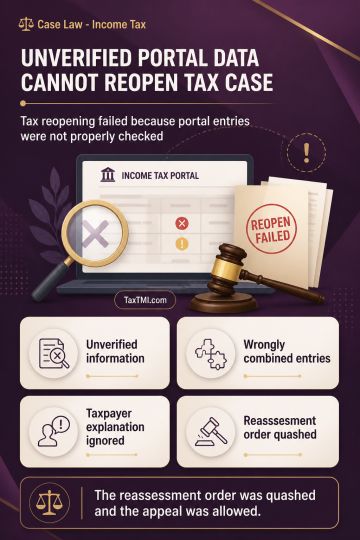
Reassessment jurisdiction fails where unverified portal information is aggregated without examining the taxpayer's explanation or relevance of entries...
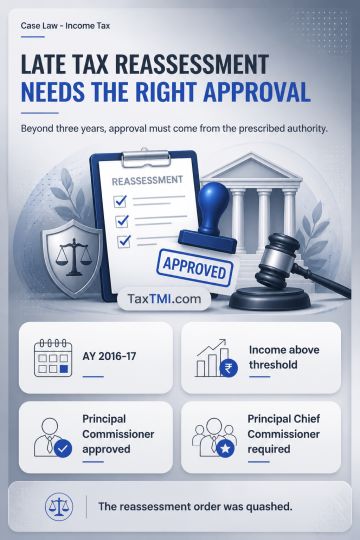
Statutory sanction for delayed reassessment requires approval from the prescribed authority; approval by an inferior authority invalidates jurisdictio...
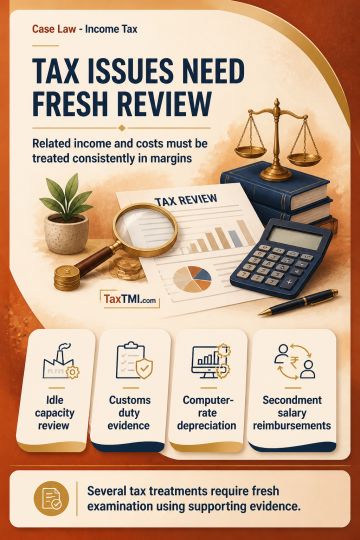
Transfer pricing margin adjustments require matching treatment of non-operating income and related costs, with comparability issues reconsidered on ev...
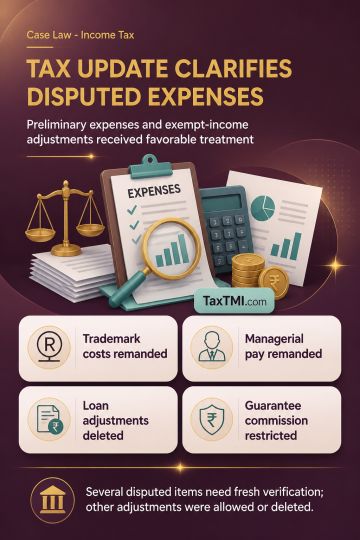
Preliminary-expense amortisation and MAT exempt-income adjustments prevailed, while trademark costs and managerial remuneration require fresh verifica...
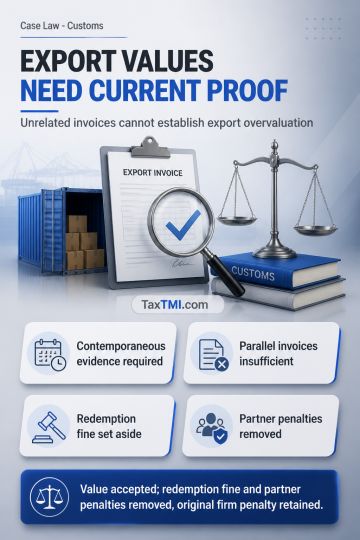
Export valuation requires contemporaneous evidence; unrelated invoices cannot prove overvaluation, and dual penalties on firm and partner are impermis...
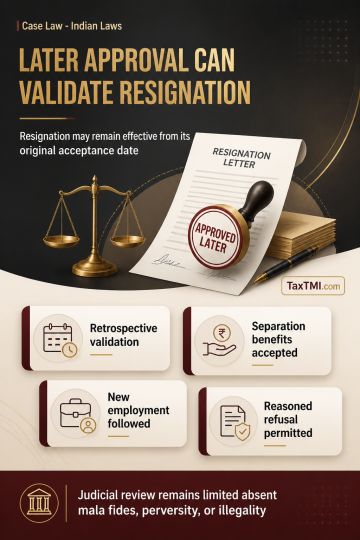
Ratification of resignation acceptance validates separation retrospectively, while withdrawal may be refused through reasoned administrative discretio...
FOB value under the export contract was treated as the...
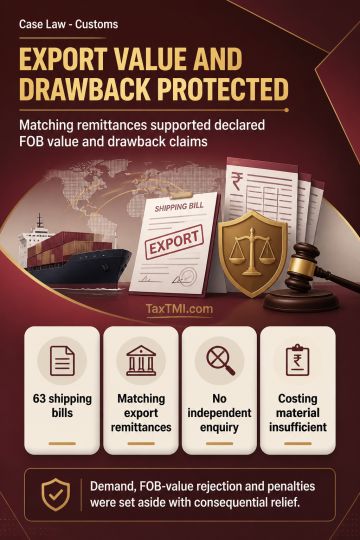
FOB transaction value and export incentives: customs valuation cannot override contractual export benefits or support confiscation without valid proof.
Contents
Summary
Note
Bookmark
Share
✓ Copied successfully !
Print
Print Options
For full text, please login
Login to TaxTMI
Verification Pending
The Email Id has not been verified. Click on the link we have sent on
FOB value under the export contract was treated as the transaction value, and customs officers could not revise that contractual value to reduce drawback or MEIS benefits, because customs valuation under section 14 and the Export Valuation Rules operates only for customs purposes. The Tribunal further held that statements recorded under section 108 were inadmissible without compliance with section 138B, and the market enquiry report could not sustain residual valuation because it relied on concepts not recognised by the valuation rules. Since the goods matched the declaration and the dispute was only about valuation, confiscation under section 113(i), redemption fine and consequential penalties under sections 114(iii) and 114AA could not survive.
FOB value under the export contract was treated as the transaction value, and customs officers could not revise that contractual value to reduce drawback or MEIS benefits, because customs valuation under section 14 and the Export Valuation Rules operates only for customs purposes. The Tribunal further held that statements recorded under section 108 were inadmissible without compliance with section 138B, and the market enquiry report could not sustain residual valuation because it relied on concepts not recognised by the valuation rules. Since the goods matched the declaration and the dispute was only about valuation, confiscation under section 113(i), redemption fine and consequential penalties under sections 114(iii) and 114AA could not survive.
Note: It is a system-generated summary and is for quick reference only.
 TaxTMI
  TaxTMI
 of 4817





 Join Channel


