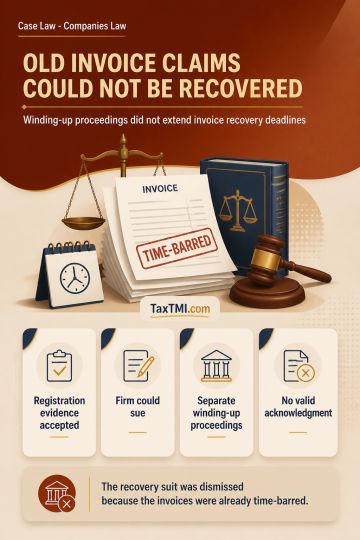
Invoice-based recovery claims remain time-barred despite separate winding-up proceedings, absent valid acknowledgment or part-payment of the disputed ...
Extended limitation fails without specific suppression allegations, while overseas employee secondment remains taxable as manpower supply within norma...
Time-share accommodation classification excludes Club or Association Service where purchasers receive contractual occupancy rights without genuine mem...
CENVAT credit for trading requires reversal, while taxable-service rental credit remains proportionately available and limitation issues await resolut...
Page of 4817
Press 'Enter' after typing page number.
561 to 580 of 96333 Results
❮
❯
❯❯
0 / 200
Expand Note
Add to Folder
No Folders have been created
+
Are you sure you want to delete "My most important" ?
Section 9D compliance is mandatory before statements recorded under section 14 of the Central Excise Act can be relied on; where the maker is not first examined and the statement is not admitted in accordance with section 9D, denial of cross-examination does not cure the defect, and such statements cannot support the demand. Clandestine manufacture and removal must be proved by positive, clinching corroborative evidence; in the absence of documentary support, excess inputs, unrecorded production, stock discrepancy, or transport records, the allegation failed. Penalty under rule 26 also could not stand without a finding that the goods were liable to confiscation, so the duty demand and penalties were set aside.
Section 9D compliance is mandatory before statements recorded under section 14 of the Central Excise Act can be relied on; where the maker is not first examined and the statement is not admitted in accordance with section 9D, denial of cross-examination does not cure the defect, and such statements cannot support the demand. Clandestine manufacture and removal must be proved by positive, clinching corroborative evidence; in the absence of documentary support, excess inputs, unrecorded production, stock discrepancy, or transport records, the allegation failed. Penalty under rule 26 also could not stand without a finding that the goods were liable to confiscation, so the duty demand and penalties were set aside.
Note: It is a system-generated summary and is for quick reference only.
 TaxTMI
  TaxTMI
 of 4817

















 Join Channel


