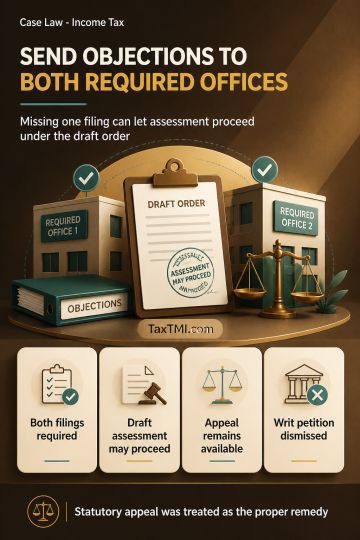
Dispute Resolution Panel objections must reach both prescribed forums; otherwise assessment may proceed and statutory appeal remains the proper remedy...
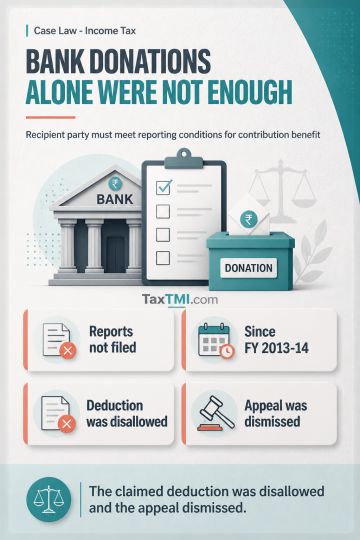
Political contribution deductions require recipient party compliance with contribution-reporting conditions; banking-channel donations alone do not qu...
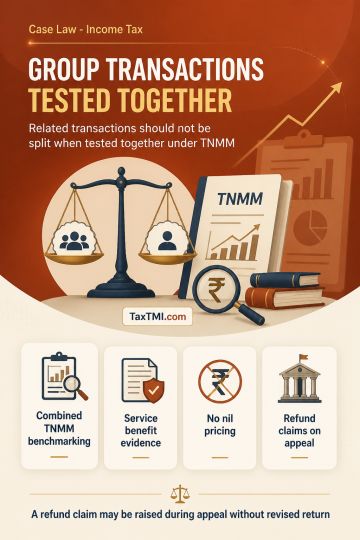
Aggregation under TNMM prevents selective testing of intra-group services without comparable uncontrolled transactions, while appellate additional cla...
Protective assessment cannot duplicate identical receipts under competing characterisations; remote services did not establish a taxable permanent est...
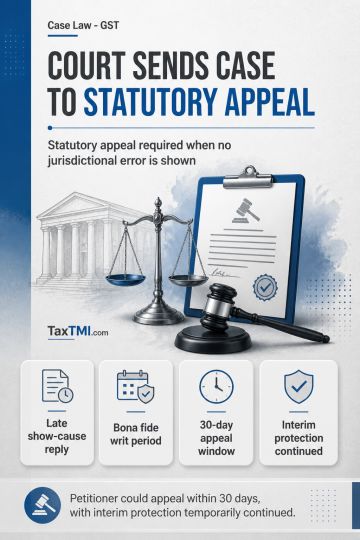
A writ petition challenging an order-in-original and recovery proceedings was not entertained because the petitioner had an available statutory appellate remedy with a prescribed limitation period and limited condonation, but failed to use it in time. The High Court held that Article 226 cannot ordinarily be invoked to bypass the statutory machinery where the party has disabled itself from pursuing the appellate remedy by its own default. Relying on Supreme Court authority, the Court declined writ jurisdiction and dismissed the petition after finding that the permissible appellate period had already expired.
A writ petition challenging an order-in-original and recovery proceedings was not entertained because the petitioner had an available statutory appellate remedy with a prescribed limitation period and limited condonation, but failed to use it in time. The High Court held that Article 226 cannot ordinarily be invoked to bypass the statutory machinery where the party has disabled itself from pursuing the appellate remedy by its own default. Relying on Supreme Court authority, the Court declined writ jurisdiction and dismissed the petition after finding that the permissible appellate period had already expired.
Note: It is a system-generated summary and is for quick reference only.
 TaxTMI
  TaxTMI
 of 4826







 Join Channel