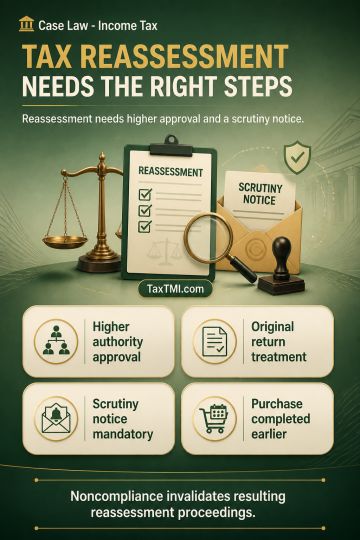
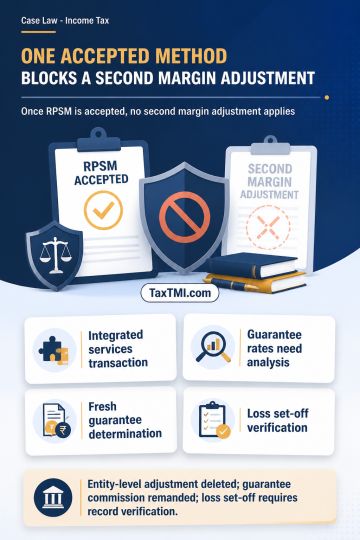
Under-reporting on a first reassessment return attracts penalty, while enhanced misreporting penalty requires proof of a statutory misreporting catego...
Form 26AS evidence requires successor-entity accounting verification after business transfer, while invoice-supported related-party advertising expend...
Money-laundering judgment timing requires awaiting the scheduled-offence decision despite continuation of the underlying trial where outcomes directly...
Page of 4921
Press 'Enter' after typing page number.
141 to 160 of 98407 Results
❮
❯
❯❯
0 / 200
Expand Note
Add to Folder
No Folders have been created
+
Are you sure you want to delete "My most important" ?
Section 54 exemption was allowed for investment in more than one residential property, with the Tribunal accepting that the word "a" can encompass more than one house where supported by precedent. It also held that investments made after the due date for filing the income tax return could still be considered for exemption, even if not deposited in the capital gains scheme, and directed the Assessing Officer to allow relief on that basis. The result was that the assessee remained eligible for Section 54 relief on both the multiple-property investment and the delayed investment.
Section 54 exemption was allowed for investment in more than one residential property, with the Tribunal accepting that the word "a" can encompass more than one house where supported by precedent. It also held that investments made after the due date for filing the income tax return could still be considered for exemption, even if not deposited in the capital gains scheme, and directed the Assessing Officer to allow relief on that basis. The result was that the assessee remained eligible for Section 54 relief on both the multiple-property investment and the delayed investment.
Note: It is a system-generated summary and is for quick reference only.
 TaxTMI
  TaxTMI
 of 4921