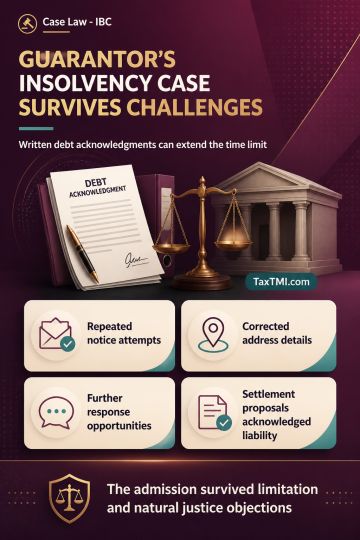
Service of notice and contractual debt acknowledgment preserved insolvency admission against a corporate guarantor despite limitation and natural just...
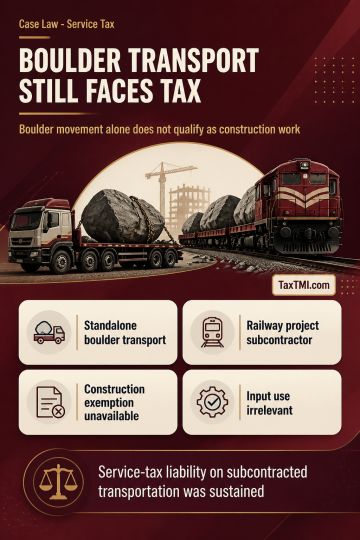
Original works exemption excludes standalone boulder transportation, leaving subcontracted railway-project transport services subject to service tax l...
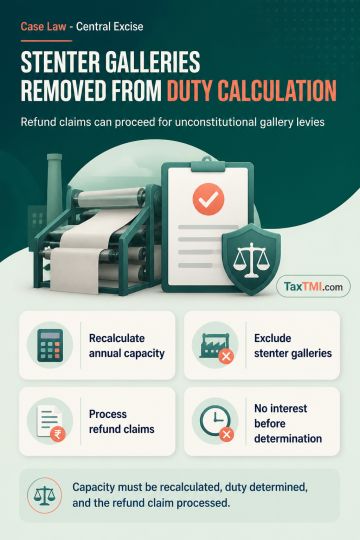
Annual production capacity determinations excluding stenter galleries support refunds for unconstitutional excise levies without an unjust-enrichment ...
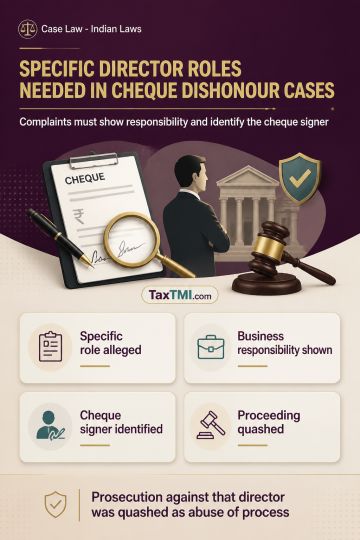
Vicarious liability for cheque dishonour requires specific allegations of responsibility and cheque signatory; generic director allegations cannot sus...
IT Resilience Index requires market infrastructure institutions to automate resilience scoring, early warnings, and continuous service-delivery monito...
Tax liability arising during CIRP was not extinguished by the approved resolution plan, because the plan showed awareness of pending tax compliances, the NCLT did not grant a blanket waiver of statutory dues, and reliefs were left to the appropriate forum. The Court held that the clean slate principle and the Supreme Court rulings in Essar Steel and Ghanashyam Mishra applied to pre-CIRP dues, not liabilities incurred during CIRP; the reassessment challenge therefore failed. On delayed return filing and carry forward of losses, the petitioner was required to seek condonation under the statutory mechanism, including CBDT action under section 119(2)(b), and could not obtain such relief in writ proceedings. The writ petition was dismissed.
Tax liability arising during CIRP was not extinguished by the approved resolution plan, because the plan showed awareness of pending tax compliances, the NCLT did not grant a blanket waiver of statutory dues, and reliefs were left to the appropriate forum. The Court held that the clean slate principle and the Supreme Court rulings in Essar Steel and Ghanashyam Mishra applied to pre-CIRP dues, not liabilities incurred during CIRP; the reassessment challenge therefore failed. On delayed return filing and carry forward of losses, the petitioner was required to seek condonation under the statutory mechanism, including CBDT action under section 119(2)(b), and could not obtain such relief in writ proceedings. The writ petition was dismissed.
Note: It is a system-generated summary and is for quick reference only.
 TaxTMI
  TaxTMI
 of 4828









 Join Channel