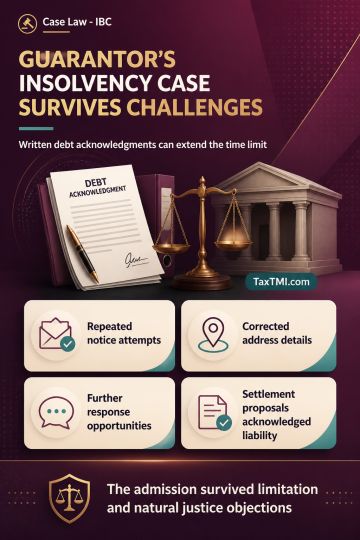
Service of notice and contractual debt acknowledgment preserved insolvency admission against a corporate guarantor despite limitation and natural just...
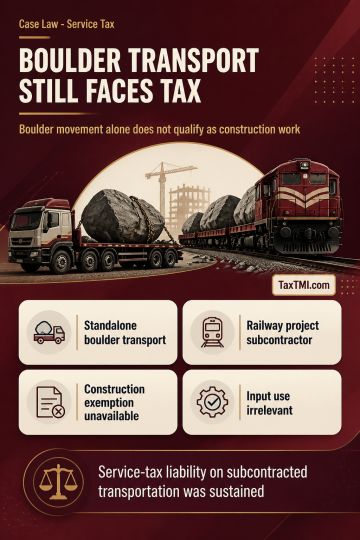
Original works exemption excludes standalone boulder transportation, leaving subcontracted railway-project transport services subject to service tax l...
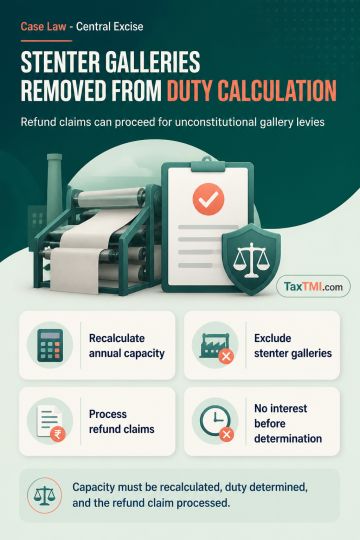
Annual production capacity determinations excluding stenter galleries support refunds for unconstitutional excise levies without an unjust-enrichment ...
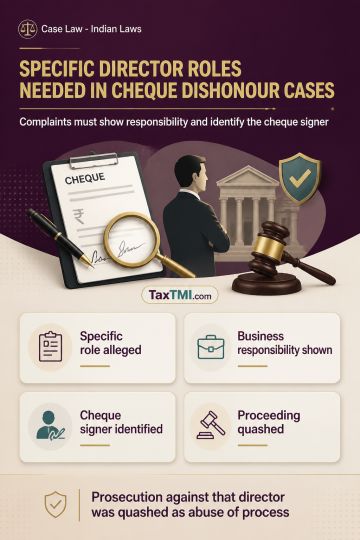
Vicarious liability for cheque dishonour requires specific allegations of responsibility and cheque signatory; generic director allegations cannot sus...
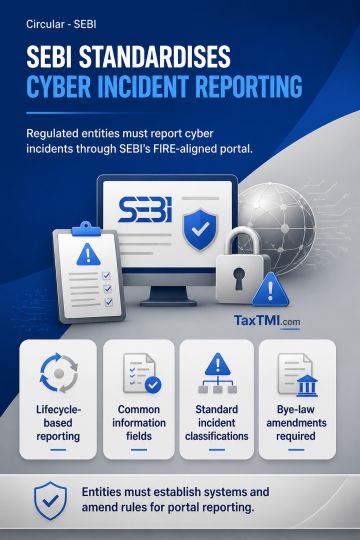
IT Resilience Index requires market infrastructure institutions to automate resilience scoring, early warnings, and continuous service-delivery monito...
Section 7 insolvency proceedings were held to be within limitation because the corporate debtor's liability was repeatedly acknowledged in balance sheets, one-time settlement proposals and an email communication, attracting Section 18 of the Limitation Act and extending time. The Tribunal also applied the principle that a recovery certificate can constitute a fresh cause of action for initiating insolvency proceedings, so the application could not be treated as time-barred. On substitution, it ruled that the deceased appellant's legal heir could continue the pending appeal, since substitution had already been permitted and the heir merely stepped into the appellant's shoes to preserve the existing proceedings. The limitation objection and the maintainability challenge were rejected.
Section 7 insolvency proceedings were held to be within limitation because the corporate debtor's liability was repeatedly acknowledged in balance sheets, one-time settlement proposals and an email communication, attracting Section 18 of the Limitation Act and extending time. The Tribunal also applied the principle that a recovery certificate can constitute a fresh cause of action for initiating insolvency proceedings, so the application could not be treated as time-barred. On substitution, it ruled that the deceased appellant's legal heir could continue the pending appeal, since substitution had already been permitted and the heir merely stepped into the appellant's shoes to preserve the existing proceedings. The limitation objection and the maintainability challenge were rejected.
Note: It is a system-generated summary and is for quick reference only.
 TaxTMI
  TaxTMI
 of 4828







 Join Channel