Capital-goods exemption covers plant-modernisation accessories, while the import restriction applies only to earlier capital-goods components and spar...
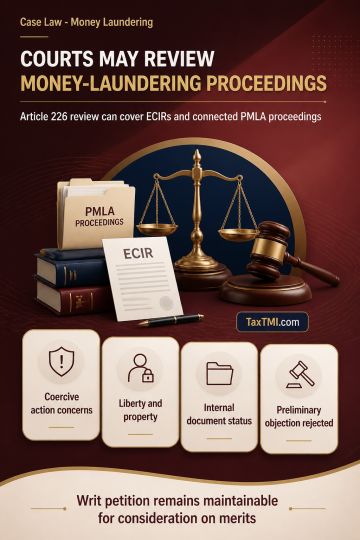
Constitutional judicial review permits challenges to ECIRs and connected money-laundering proceedings where coercive action affects fundamental intere...
An inchoate agreement to sell, lacking execution by both parties and showing patent ambiguity, could not be treated as conclusive evidence of receipt of unaccounted on-money. The Tribunal held that an admission must be clear, unambiguous and unconditional, and that the seized document, without material particulars such as witness details or the drafter's identity and without the beneficiary's participation, did not justify an inference of undisclosed cash receipts. The additions based on that document were therefore deleted, and the consequential penalty was also deleted.
An inchoate agreement to sell, lacking execution by both parties and showing patent ambiguity, could not be treated as conclusive evidence of receipt of unaccounted on-money. The Tribunal held that an admission must be clear, unambiguous and unconditional, and that the seized document, without material particulars such as witness details or the drafter's identity and without the beneficiary's participation, did not justify an inference of undisclosed cash receipts. The additions based on that document were therefore deleted, and the consequential penalty was also deleted.
Note: It is a system-generated summary and is for quick reference only.
 TaxTMI
 of 4788








 Join Channel


 TaxTMI