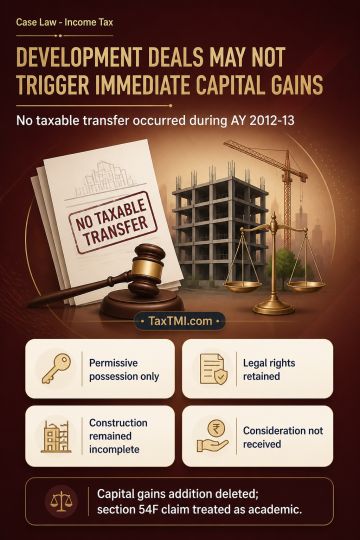
Development agreements require legal possession or effective enjoyment for capital gains transfer; permissive possession and deferred consideration de...
Prolonged sterilisation of development rights supports capital-gains treatment, while business-income disallowances cannot govern capital-gains comput...
Additional evidence in transfer pricing dispute leads to fresh examination, while tax deductions, TDS credit, fee and refund interest require verifica...
Category II AIF pass-through taxation preserves non-business income character; investment receipts cannot be reclassified without applying recognised ...
Mutual fund maturity rules require proper rollover, redemption, disclosure, and due diligence; investor gains cannot excuse regulatory breaches or pen...
The SC held that a cash security deposit made before CIRP remained the corporate debtor's property until actual appropriation, and its unilateral adjustment after commencement of CIRP towards pre-CIRP dues violated the moratorium and the pari passu scheme of insolvency law. Because the appellant had no mutual cross-demands justifying set-off and had already lodged its claim in the insolvency process, recovery of those dues had to proceed through that process. The Court also found that no bank guarantee or letter of credit existed; the deposit did not create a security interest or secured creditor status, so authorities on enforcement of such instruments were inapplicable. The deposit could be adjusted only in accordance with the insolvency process and towards post-CIRP dues.
The SC held that a cash security deposit made before CIRP remained the corporate debtor's property until actual appropriation, and its unilateral adjustment after commencement of CIRP towards pre-CIRP dues violated the moratorium and the pari passu scheme of insolvency law. Because the appellant had no mutual cross-demands justifying set-off and had already lodged its claim in the insolvency process, recovery of those dues had to proceed through that process. The Court also found that no bank guarantee or letter of credit existed; the deposit did not create a security interest or secured creditor status, so authorities on enforcement of such instruments were inapplicable. The deposit could be adjusted only in accordance with the insolvency process and towards post-CIRP dues.
Note: It is a system-generated summary and is for quick reference only.
 TaxTMI
  TaxTMI
 of 4827
















 Join Channel