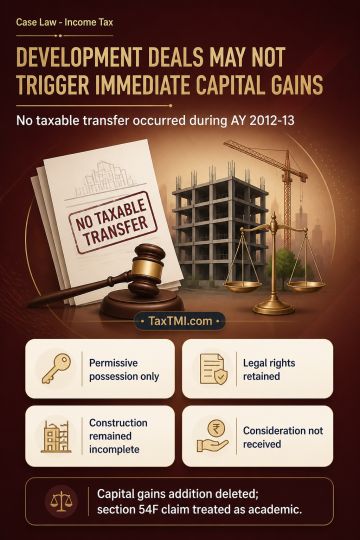
Development agreements require legal possession or effective enjoyment for capital gains transfer; permissive possession and deferred consideration de...
Prolonged sterilisation of development rights supports capital-gains treatment, while business-income disallowances cannot govern capital-gains comput...
Additional evidence in transfer pricing dispute leads to fresh examination, while tax deductions, TDS credit, fee and refund interest require verifica...
Category II AIF pass-through taxation preserves non-business income character; investment receipts cannot be reclassified without applying recognised ...
Mutual fund maturity rules require proper rollover, redemption, disclosure, and due diligence; investor gains cannot excuse regulatory breaches or pen...
NCLAT held that a Section 95 application against a personal guarantor was not maintainable where the guarantee had not been invoked before the Form B demand notice. The tribunal ruled that the Adjudicating Authority erred in treating the demand notice itself as invocation, because the legal scheme required the guarantor's liability to arise earlier. It also rejected reliance on an alleged prior invocation notice, since the application did not plead it, the supporting documents did not include it, and reliance on it had been expressly abandoned before the Adjudicating Authority. The admission order was set aside, leaving the creditor free to pursue other remedies available in law.
NCLAT held that a Section 95 application against a personal guarantor was not maintainable where the guarantee had not been invoked before the Form B demand notice. The tribunal ruled that the Adjudicating Authority erred in treating the demand notice itself as invocation, because the legal scheme required the guarantor's liability to arise earlier. It also rejected reliance on an alleged prior invocation notice, since the application did not plead it, the supporting documents did not include it, and reliance on it had been expressly abandoned before the Adjudicating Authority. The admission order was set aside, leaving the creditor free to pursue other remedies available in law.
Note: It is a system-generated summary and is for quick reference only.
 TaxTMI
  TaxTMI
 of 4828


















 Join Channel