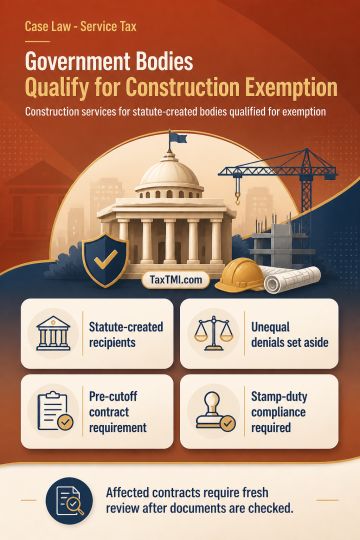
Governmental authority status supports construction-service exemption, while pre-cutoff contract and stamp-duty compliance requires verification on re...
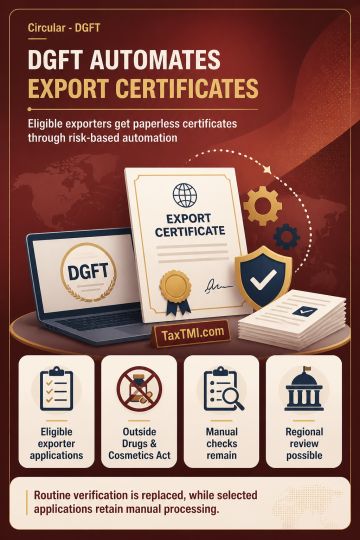
Automated Free Sale and Commerce Certificates enable paperless processing while retaining risk-based manual verification for selected exporter applica...
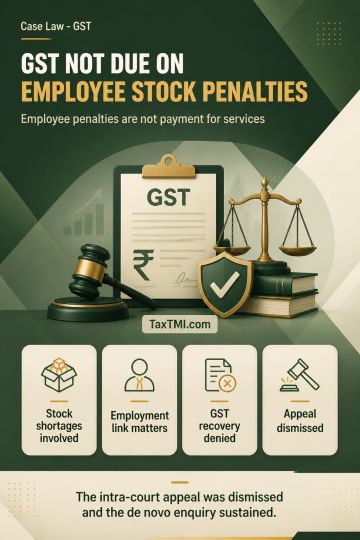
Employee stock-shortage penalties do not constitute consideration for services, preventing GST collection under Schedule II in employment relationship...
Section 114 of the Customs Act was treated as creating two distinct bases of liability: the first limb covers any act or omission that renders goods liable to confiscation, while abetment falls under the separate second limb. The Tribunal held that mens rea is not required under the first limb, so the case was to be tested on the objective effect of the appellant's conduct. Lending the CHA licence, failing to verify the exporter's credentials, and exercising no supervision over clearance activity were treated as a continuous course of conduct that directly facilitated attempted smuggling. Penalty under section 114 was therefore upheld and the appeal dismissed.
Section 114 of the Customs Act was treated as creating two distinct bases of liability: the first limb covers any act or omission that renders goods liable to confiscation, while abetment falls under the separate second limb. The Tribunal held that mens rea is not required under the first limb, so the case was to be tested on the objective effect of the appellant's conduct. Lending the CHA licence, failing to verify the exporter's credentials, and exercising no supervision over clearance activity were treated as a continuous course of conduct that directly facilitated attempted smuggling. Penalty under section 114 was therefore upheld and the appeal dismissed.
Note: It is a system-generated summary and is for quick reference only.
 TaxTMI
  TaxTMI
 of 4827



 Join Channel


