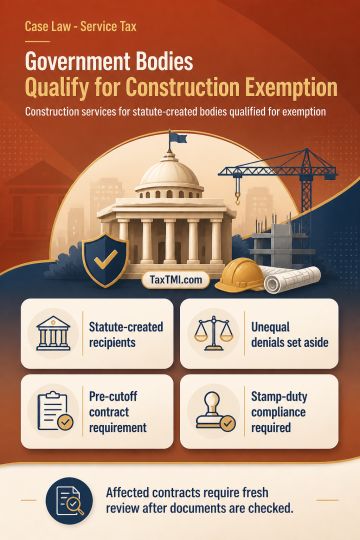
Governmental authority status supports construction-service exemption, while pre-cutoff contract and stamp-duty compliance requires verification on re...
Automated Free Sale and Commerce Certificates enable paperless processing while retaining risk-based manual verification for selected exporter applica...
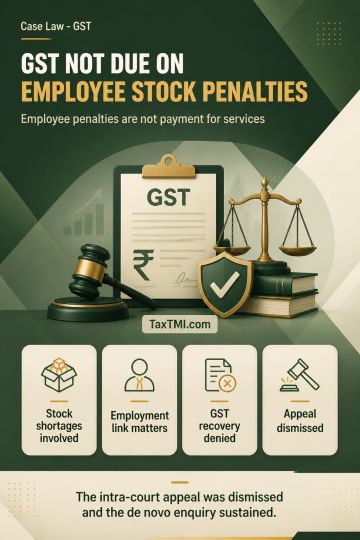
Employee stock-shortage penalties do not constitute consideration for services, preventing GST collection under Schedule II in employment relationship...
Debt and default were sufficiently proved from the Section 7 materials, including unit-wise allotment details, amounts paid, amounts claimed in default, and supporting allotment and sale documents, so admission of the CIRP was sustained. The NCLAT held that where allottees of a single real-estate project initiate insolvency, the CIRP must be confined to that project and cannot spill over to other separate projects of the same corporate debtor. The admission order was therefore modified to limit the CIRP to Raheja Shilas (Low Rise) only, while creditors linked to other projects were left free to pursue independent remedies. The CIRP was not closed, and withdrawal by settlement under Section 12A was left open.
Debt and default were sufficiently proved from the Section 7 materials, including unit-wise allotment details, amounts paid, amounts claimed in default, and supporting allotment and sale documents, so admission of the CIRP was sustained. The NCLAT held that where allottees of a single real-estate project initiate insolvency, the CIRP must be confined to that project and cannot spill over to other separate projects of the same corporate debtor. The admission order was therefore modified to limit the CIRP to Raheja Shilas (Low Rise) only, while creditors linked to other projects were left free to pursue independent remedies. The CIRP was not closed, and withdrawal by settlement under Section 12A was left open.
Note: It is a system-generated summary and is for quick reference only.
 TaxTMI
  TaxTMI
 of 4828






 Join Channel


