Form 26AS evidence requires successor-entity accounting verification after business transfer, while invoice-supported related-party advertising expend...
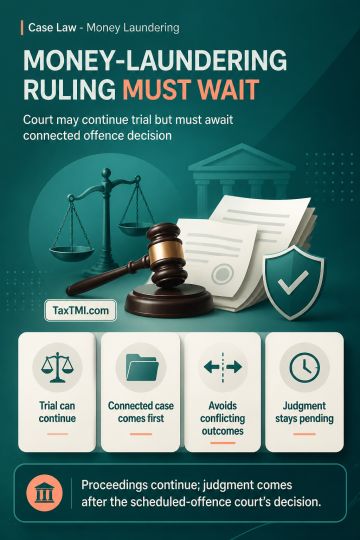
Money-laundering judgment timing requires awaiting the scheduled-offence decision despite continuation of the underlying trial where outcomes directly...
Accredited investor eligibility expands through securities-market exposure, while alternative investment fund disputes require prescribed resolution a...
Customs Assessment Portal centralises classification and valuation guidance to support consistent, transparent and informed compliance across stakehol...
Page of 4918
Press 'Enter' after typing page number.
101 to 120 of 98359 Results
❮
❯
❯❯
0 / 200
Expand Note
Add to Folder
No Folders have been created
+
Are you sure you want to delete "My most important" ?
Amendments to Accounting Standard (AS) 22 introduce Pillar Two legislation and require that enterprises do not recognise or disclose deferred tax assets or liabilities arising from Pillar Two income taxes; instead enterprises must disclose application of that exception and separately disclose current tax expense (income) related to Pillar Two. Where Pillar Two legislation is enacted or substantively enacted but not yet effective, enterprises must disclose known or reasonably estimable qualitative and quantitative exposure information (including indicative ranges), subject to an exemption for Small and Medium-sized Companies. Paragraphs 2A and 32A apply retrospectively; 32B-32D apply for annual periods beginning on or after 1 April 2025.
Amendments to Accounting Standard (AS) 22 introduce Pillar Two legislation and require that enterprises do not recognise or disclose deferred tax assets or liabilities arising from Pillar Two income taxes; instead enterprises must disclose application of that exception and separately disclose current tax expense (income) related to Pillar Two. Where Pillar Two legislation is enacted or substantively enacted but not yet effective, enterprises must disclose known or reasonably estimable qualitative and quantitative exposure information (including indicative ranges), subject to an exemption for Small and Medium-sized Companies. Paragraphs 2A and 32A apply retrospectively; 32B-32D apply for annual periods beginning on or after 1 April 2025.
Note: It is a system-generated summary and is for quick reference only.
 TaxTMI
  TaxTMI
 of 4918