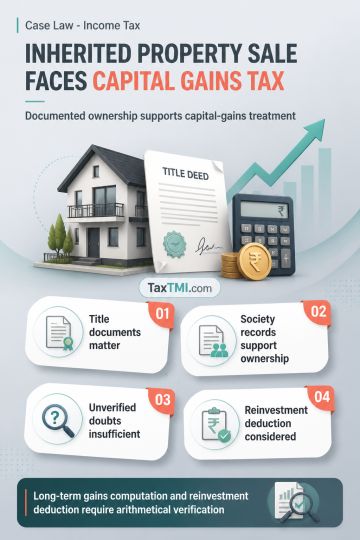
Inherited property sale proceeds require capital-gains treatment where ownership is supported by evidence, not suspicion or unverified signature doubt...
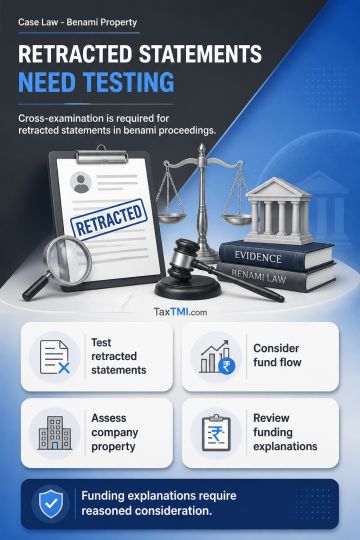
Cross-examination of retracted statements is essential where foundational evidence supports a benami allegation and documented funding explanations re...
Capital-goods exemption covers plant-modernisation accessories, while the import restriction applies only to earlier capital-goods components and spar...
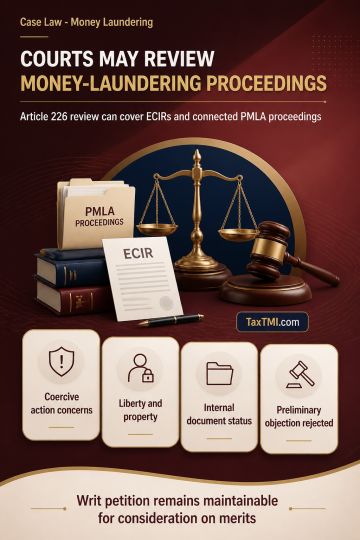
Constitutional judicial review permits challenges to ECIRs and connected money-laundering proceedings where coercive action affects fundamental intere...
Where a GST-registered company ceases to exist on amalgamation, its GST registration is to be treated as deemed cancelled from the merger effective date and orders framed in the name of the non-existent entity are invalid; the Revenue must make the successor's GST registration operational and upload adjudication orders and any demands against the successor's GST number, which the successor must contest or discharge according to law. Further, limitation does not bar either party from raising or contesting claims arising from those uploaded orders in view of Section 75(3) of the CGST Act, and the petitioner remains free to pursue remedies.
Where a GST-registered company ceases to exist on amalgamation, its GST registration is to be treated as deemed cancelled from the merger effective date and orders framed in the name of the non-existent entity are invalid; the Revenue must make the successor's GST registration operational and upload adjudication orders and any demands against the successor's GST number, which the successor must contest or discharge according to law. Further, limitation does not bar either party from raising or contesting claims arising from those uploaded orders in view of Section 75(3) of the CGST Act, and the petitioner remains free to pursue remedies.
Note: It is a system-generated summary and is for quick reference only.
 TaxTMI
 of 4786








 Join Channel


 TaxTMI