GST refunds for cancelled air tickets remain available when passenger reimbursements defeat unjust enrichment and credit-note adjustment is unavailabl...
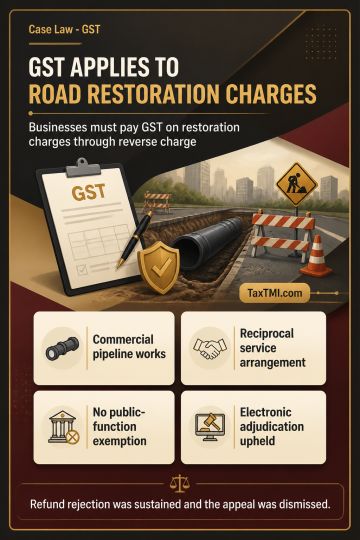
Request-driven road restoration attracts reverse-charge GST, not governmental-function treatment or compensatory-damages status for business recipient...
Road restoration charges for commercial pipeline works are taxable Government services, with reverse charge liability and no public-function exemption...
Taxability of excess stock discovered on survey: where excess items formed part of undifferentiated total stock discovered before year-end and the assessee admitted and included the amount in the profit and loss account and return, the excess represents undeclared business receipts rather than an identifiable investment. Applying settled authority, the deeming fiction for unexplained investment cannot be invoked for non-identifiable mixed stock and the special tax rate provision does not apply where the amount is offered and accepted as business income. Outcome: appeal allowed; excess stock taxed as business income, not under unexplained investment rules.
Taxability of excess stock discovered on survey: where excess items formed part of undifferentiated total stock discovered before year-end and the assessee admitted and included the amount in the profit and loss account and return, the excess represents undeclared business receipts rather than an identifiable investment. Applying settled authority, the deeming fiction for unexplained investment cannot be invoked for non-identifiable mixed stock and the special tax rate provision does not apply where the amount is offered and accepted as business income. Outcome: appeal allowed; excess stock taxed as business income, not under unexplained investment rules.
Note: It is a system-generated summary and is for quick reference only.
 TaxTMI
  TaxTMI
 of 4920