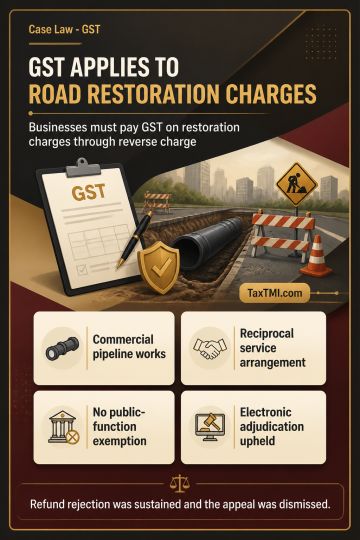
Request-driven road restoration attracts reverse-charge GST, not governmental-function treatment or compensatory-damages status for business recipient...
Road restoration charges for commercial pipeline works are taxable Government services, with reverse charge liability and no public-function exemption...
Model-wise import cap monitoring cannot justify withholding used multifunction machines where all-India tracking is absent and full security is furnis...
The text addresses whether the adjudicatory authority may extend the Personal Insolvency Resolution Process (PIRP) beyond procedural timeline lapses while the statutory moratorium remains time-capped. It reasons that procedural timelines in the applicable regulation (including the 120 day filing requirement) are directory, not automatically fatal, and that the authority retains jurisdiction to permit extensions where stakeholders authorise and sufficient reasons exist; however the moratorium itself cannot be extended beyond its statutory outer limit. The conclusion reversed the rejection of extension applications and permitted adjudication of the repayment plan on the extended PIRP timeline.
The text addresses whether the adjudicatory authority may extend the Personal Insolvency Resolution Process (PIRP) beyond procedural timeline lapses while the statutory moratorium remains time-capped. It reasons that procedural timelines in the applicable regulation (including the 120 day filing requirement) are directory, not automatically fatal, and that the authority retains jurisdiction to permit extensions where stakeholders authorise and sufficient reasons exist; however the moratorium itself cannot be extended beyond its statutory outer limit. The conclusion reversed the rejection of extension applications and permitted adjudication of the repayment plan on the extended PIRP timeline.
Note: It is a system-generated summary and is for quick reference only.
 TaxTMI
  TaxTMI
 of 4918