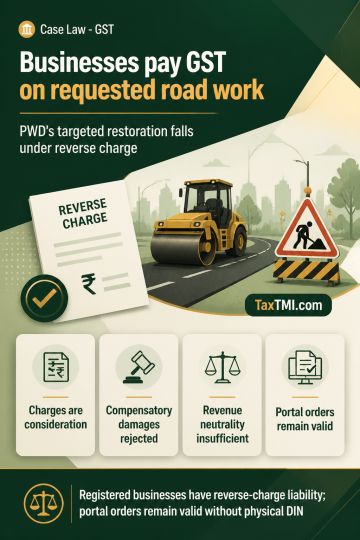
Request-driven road restoration attracts reverse-charge GST, not governmental-function treatment or compensatory-damages status for business recipient...
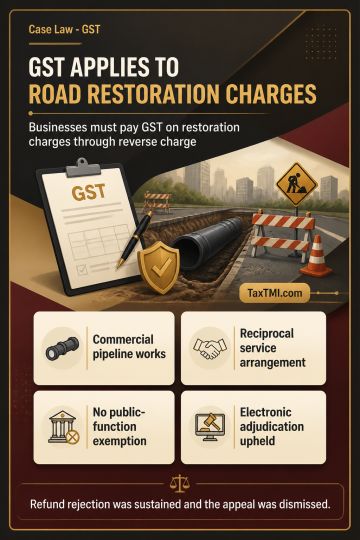
Road restoration charges for commercial pipeline works are taxable Government services, with reverse charge liability and no public-function exemption...
Model-wise import cap monitoring cannot justify withholding used multifunction machines where all-India tracking is absent and full security is furnis...
The note addresses classification and tax treatment of hookah served within restaurant premises, applying ejusdem generis to read "any other article for human consumption" as limited to substances ingested via the alimentary canal; smoke inhaled from hookah therefore falls outside the food/drink concept. It concludes hookah supplies constitute a composite supply whose principal element is the goods used for smoking, so the transaction is treated as supply of goods under the principal-supply rule. Consequent effects: food continues to be taxed as restaurant service at the concessional rate, tobacco-based hookah is taxed under tobacco product classification, and described non-tobacco smoking preparations are taxed as goods under their appropriate HSN classification.
The note addresses classification and tax treatment of hookah served within restaurant premises, applying ejusdem generis to read "any other article for human consumption" as limited to substances ingested via the alimentary canal; smoke inhaled from hookah therefore falls outside the food/drink concept. It concludes hookah supplies constitute a composite supply whose principal element is the goods used for smoking, so the transaction is treated as supply of goods under the principal-supply rule. Consequent effects: food continues to be taxed as restaurant service at the concessional rate, tobacco-based hookah is taxed under tobacco product classification, and described non-tobacco smoking preparations are taxed as goods under their appropriate HSN classification.
Note: It is a system-generated summary and is for quick reference only.
 TaxTMI
  TaxTMI
 of 4912