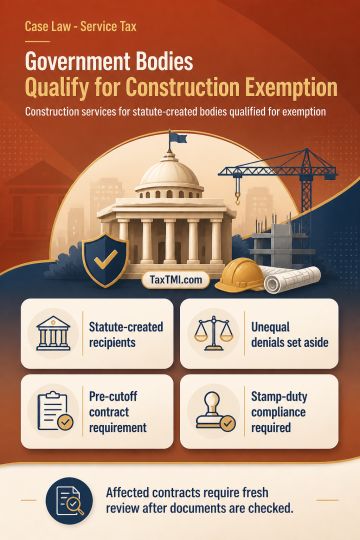
Governmental authority status supports construction-service exemption, while pre-cutoff contract and stamp-duty compliance requires verification on re...
Automated Free Sale and Commerce Certificates enable paperless processing while retaining risk-based manual verification for selected exporter applica...
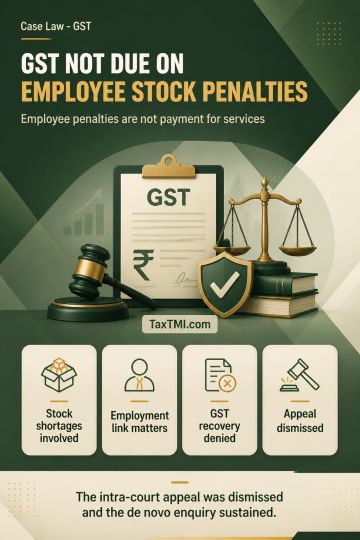
Employee stock-shortage penalties do not constitute consideration for services, preventing GST collection under Schedule II in employment relationship...
Where long-term capital gains from sale of a residential house...
Capital gains exemption: payment for plot, architect fees and bona fide commencement of construction can satisfy utilisation requirement and secure relief.
Contents
Summary
Note
Bookmark
Share
✓ Copied successfully !
Print
Print Options
For full text, please login
Login to TaxTMI
Verification Pending
The Email Id has not been verified. Click on the link we have sent on
Where long-term capital gains from sale of a residential house were applied to purchase of a plot, payment of architect fees and deposits, and bona fide commencement of construction within the statutory three-year window, such application constitutes 'utilisation' of capital gains for the purpose of the exemption. The piece treats the exemption as beneficial, relies on precedent holding that advances and commencement of construction satisfy the utilisation requirement even if physical completion and plan sanction occur after three years, and concludes exemption should be allowed on proof of investment and commencement.
Where long-term capital gains from sale of a residential house were applied to purchase of a plot, payment of architect fees and deposits, and bona fide commencement of construction within the statutory three-year window, such application constitutes 'utilisation' of capital gains for the purpose of the exemption. The piece treats the exemption as beneficial, relies on precedent holding that advances and commencement of construction satisfy the utilisation requirement even if physical completion and plan sanction occur after three years, and concludes exemption should be allowed on proof of investment and commencement.
Note: It is a system-generated summary and is for quick reference only.
 TaxTMI
  TaxTMI
 of 4827






 Join Channel


