Form 26AS evidence requires successor-entity accounting verification after business transfer, while invoice-supported related-party advertising expend...
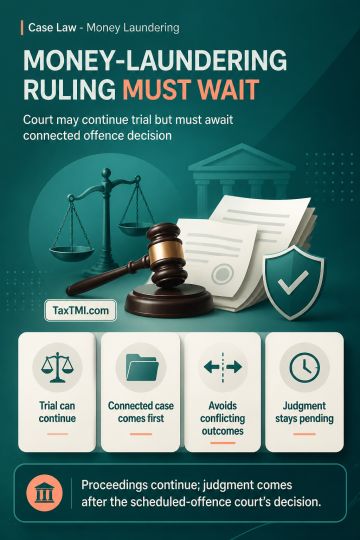
Money-laundering judgment timing requires awaiting the scheduled-offence decision despite continuation of the underlying trial where outcomes directly...
Accredited investor eligibility expands through securities-market exposure, while alternative investment fund disputes require prescribed resolution a...
Customs Assessment Portal centralises classification and valuation guidance to support consistent, transparent and informed compliance across stakehol...
Page of 4918
Press 'Enter' after typing page number.
101 to 120 of 98359 Results
❮
❯
❯❯
0 / 200
Expand Note
Add to Folder
No Folders have been created
+
Are you sure you want to delete "My most important" ?
Disallowance of salary recharges and expense reimbursements was challenged where revenue relied on absence of detailed employee-wise service records and plain-paper cost-sharing agreements; AO made no finding that payments were excessive or provided no comparison with fair market value or benefit derived. The article explains that section 40A(2) requires formation of an opinion that expenditure is excessive or unreasonable before disallowance, and that under section 37(1) the assessee bears onus to prove business purpose. Absent a finding of excessiveness, mere lack of minute service details does not justify denying the claimed expenditure; the disallowance was held unsustainable and the appeal allowed.
Disallowance of salary recharges and expense reimbursements was challenged where revenue relied on absence of detailed employee-wise service records and plain-paper cost-sharing agreements; AO made no finding that payments were excessive or provided no comparison with fair market value or benefit derived. The article explains that section 40A(2) requires formation of an opinion that expenditure is excessive or unreasonable before disallowance, and that under section 37(1) the assessee bears onus to prove business purpose. Absent a finding of excessiveness, mere lack of minute service details does not justify denying the claimed expenditure; the disallowance was held unsustainable and the appeal allowed.
Note: It is a system-generated summary and is for quick reference only.
 TaxTMI
  TaxTMI
 of 4918