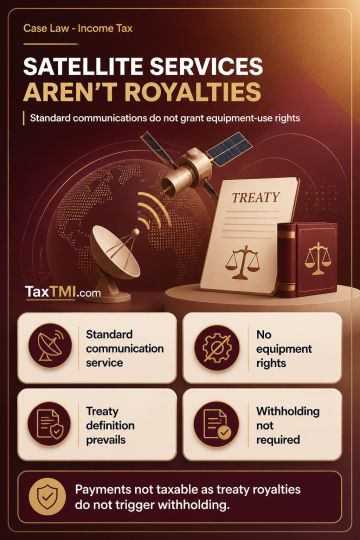
Article 8 treaty coverage excluded third-party airline support services, while documented demonetisation cash receipts remained accepted business inco...
Functional comparability under TNMM requires highway contract benchmarks to reflect operation, maintenance and transfer activities, requiring fresh be...
Objective characteristics govern magnesium bis-glycinate chelate classification as an amino-acid coordination compound, not a food preparation or anti...
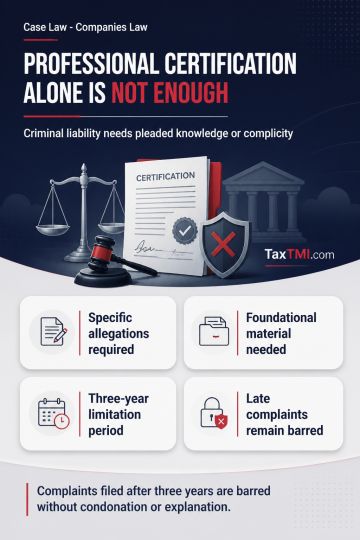
Independent professional certification requires pleaded knowledge or complicity for criminal liability; untimely complaints remain barred by limitatio...
Classification guidance applies GIR principles and HSN Explanatory Notes to determine tariff headings for internally or externally threaded pipe fittings. The note instructs preference for specific tariff entries over residuary entries, applying the General Rules of Interpretation to identify 'elbows, bends, sleeves, tees and crosses' as included shapes. Operatively, such fittings are classifiable by material under the Customs Tariff: stainless steel under HS 73072200, copper under HS 74121000, brass under HS 74122019, and bronze under HS 74122090, with thread type (internal/external) and tapered self-sealing design treated as characteristic features.
Classification guidance applies GIR principles and HSN Explanatory Notes to determine tariff headings for internally or externally threaded pipe fittings. The note instructs preference for specific tariff entries over residuary entries, applying the General Rules of Interpretation to identify 'elbows, bends, sleeves, tees and crosses' as included shapes. Operatively, such fittings are classifiable by material under the Customs Tariff: stainless steel under HS 73072200, copper under HS 74121000, brass under HS 74122019, and bronze under HS 74122090, with thread type (internal/external) and tapered self-sealing design treated as characteristic features.
Note: It is a system-generated summary and is for quick reference only.
 TaxTMI
 of 4801













 Join Channel


 TaxTMI
