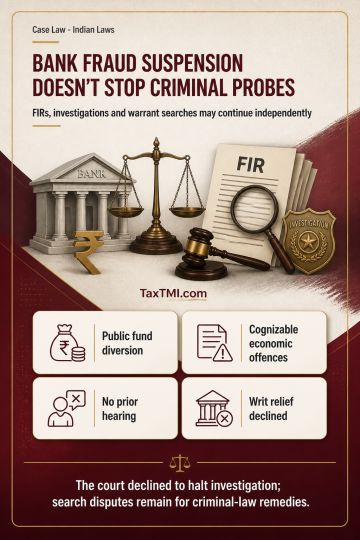
Administrative fraud classification suspension does not halt independent criminal investigation or warrant-based searches into alleged economic offenc...
Arrest safeguards and transit remand requirements invalidated detention following inter-State transfer without communicated grounds or magistrate auth...
Arrest safeguards require disclosed grounds, relative intimation and transit remand, while duplicate prosecution under the CGST framework is unsustain...
Document Identification Number defects can invalidate GST assessments, with delayed challenges entertained conditionally where patent irregularities e...
Assignment of the right to collect royalty by a State to a...
Reverse charge and assignment of royalty collection: exemption for excess royalty collectors subject to reconciliation; leaseholders remain liable under RCM
Contents
Summary
Note
Bookmark
Share
✓ Copied successfully !
Print
Print Options
For full text, please login
Login to TaxTMI
Verification Pending
The Email Id has not been verified. Click on the link we have sent on
Assignment of the right to collect royalty by a State to a contractor is treated as a taxable licensing service, but Entry 65B in Notification No.12/2017 (as amended) exempts services to Excess Royalty Collection Contractors (ERCC) subject to reconciliation and end of contract certification; consequence: ERCCs obtain conditional exemption on the assigned right fees. Separately, statutory levies (royalty, seigniorage, DMF, MERIT) remain taxable under the Reverse Charge Mechanism and are payable by the quarry/mining leaseholders; consequence: ERCCs collect and remit these amounts but do not bear GST on them, although ERCCs must pay GST on collection/agency services they provide to the Government.
Assignment of the right to collect royalty by a State to a contractor is treated as a taxable licensing service, but Entry 65B in Notification No.12/2017 (as amended) exempts services to Excess Royalty Collection Contractors (ERCC) subject to reconciliation and end of contract certification; consequence: ERCCs obtain conditional exemption on the assigned right fees. Separately, statutory levies (royalty, seigniorage, DMF, MERIT) remain taxable under the Reverse Charge Mechanism and are payable by the quarry/mining leaseholders; consequence: ERCCs collect and remit these amounts but do not bear GST on them, although ERCCs must pay GST on collection/agency services they provide to the Government.
Note: It is a system-generated summary and is for quick reference only.
 TaxTMI
 of 4803












 Join Channel


 TaxTMI
