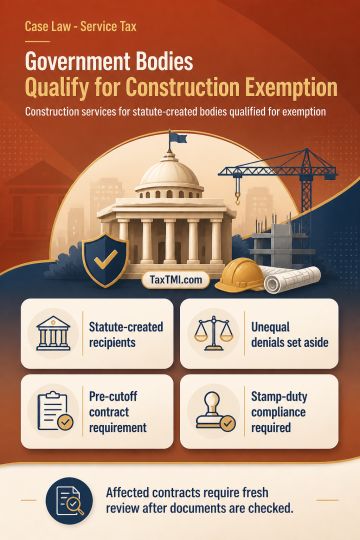
Governmental authority status supports construction-service exemption, while pre-cutoff contract and stamp-duty compliance requires verification on re...
Automated Free Sale and Commerce Certificates enable paperless processing while retaining risk-based manual verification for selected exporter applica...
Employee stock-shortage penalties do not constitute consideration for services, preventing GST collection under Schedule II in employment relationship...
The Order-to-Trade Ratio (OTR) framework is revised to exempt two categories from penalty calculations: orders in equity option contracts within 40% of last traded price (premium) or within INR 20, whichever is higher, and algorithmic orders placed by Designated Market Makers for marketmaking activity - each category therefore will not count towards high OTR penalties. The OTR framework continues to apply to cash and derivative segments and liquidity enhancement schemes. SEBI sets April 06, 2026 as the effective date and directs exchanges to amend byelaws and notify market participants accordingly.
The Order-to-Trade Ratio (OTR) framework is revised to exempt two categories from penalty calculations: orders in equity option contracts within 40% of last traded price (premium) or within INR 20, whichever is higher, and algorithmic orders placed by Designated Market Makers for marketmaking activity - each category therefore will not count towards high OTR penalties. The OTR framework continues to apply to cash and derivative segments and liquidity enhancement schemes. SEBI sets April 06, 2026 as the effective date and directs exchanges to amend byelaws and notify market participants accordingly.
Note: It is a system-generated summary and is for quick reference only.
 TaxTMI
  TaxTMI
 of 4828



















 Join Channel


