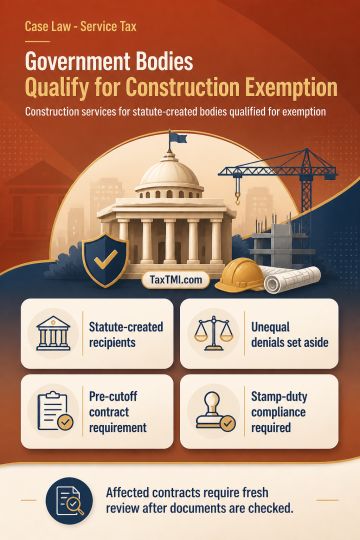
Governmental authority status supports construction-service exemption, while pre-cutoff contract and stamp-duty compliance requires verification on re...
Automated Free Sale and Commerce Certificates enable paperless processing while retaining risk-based manual verification for selected exporter applica...
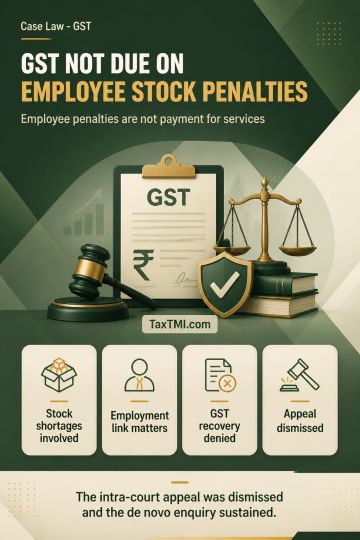
Employee stock-shortage penalties do not constitute consideration for services, preventing GST collection under Schedule II in employment relationship...
Supreme Court examined the tax treatment of amounts recovered by an employer from employees as provident or ESI contributions, noting such sums are taxable as income when received. The Court explained that deduction under the employer-deduction provision is available only if the employer credits the employees' contributions to the relevant fund by the 'due date', which the Explanation defines as the date required under the applicable Act, rule, order or notification. The Court identified two conflicting interpretations: one requiring crediting by the statutory fund due date for deduction, and an alternative treating employee and employer contributions alike under the non-obstante clause permitting deduction if deposited by return due date.
Supreme Court examined the tax treatment of amounts recovered by an employer from employees as provident or ESI contributions, noting such sums are taxable as income when received. The Court explained that deduction under the employer-deduction provision is available only if the employer credits the employees' contributions to the relevant fund by the 'due date', which the Explanation defines as the date required under the applicable Act, rule, order or notification. The Court identified two conflicting interpretations: one requiring crediting by the statutory fund due date for deduction, and an alternative treating employee and employer contributions alike under the non-obstante clause permitting deduction if deposited by return due date.
Note: It is a system-generated summary and is for quick reference only.
 TaxTMI
  TaxTMI
 of 4827






 Join Channel


