Form 26AS evidence requires successor-entity accounting verification after business transfer, while invoice-supported related-party advertising expend...
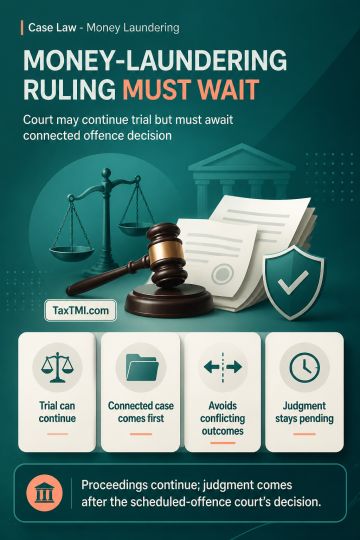
Money-laundering judgment timing requires awaiting the scheduled-offence decision despite continuation of the underlying trial where outcomes directly...
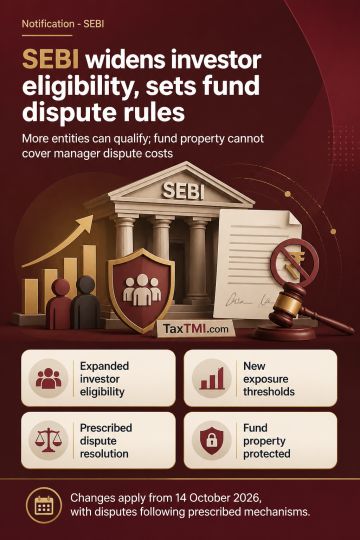
Accredited investor eligibility expands through securities-market exposure, while alternative investment fund disputes require prescribed resolution a...
Customs Assessment Portal centralises classification and valuation guidance to support consistent, transparent and informed compliance across stakehol...
Page of 4918
Press 'Enter' after typing page number.
101 to 120 of 98359 Results
❮
❯
❯❯
0 / 200
Expand Note
Add to Folder
No Folders have been created
+
Are you sure you want to delete "My most important" ?
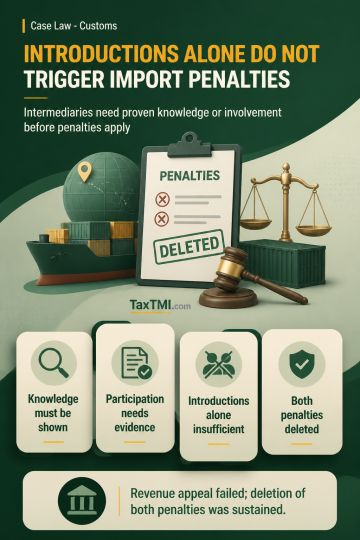
Whether the customs broker breached regulatory obligations by facilitating duty-free import clearances that were later misused: tribunal held the post-import diversion by the importer was discovered only by subsequent DRI investigation and, as customs had initially cleared goods with no indication of misuse, the broker could not be held liable for violations of Regulations 11(d), 11(e), 11(m) and 11(n); those findings were set aside. Whether the broker failed in proactive duties under Regulation 11(a)/12(a): relying on Supreme Court precedent, the broker's lack of proactive authorization/representation warranted a reduced punitive response; revocation and security forfeiture quashed but a reasonable penalty was imposed. - CESTAT
Whether the customs broker breached regulatory obligations by facilitating duty-free import clearances that were later misused: tribunal held the post-import diversion by the importer was discovered only by subsequent DRI investigation and, as customs had initially cleared goods with no indication of misuse, the broker could not be held liable for violations of Regulations 11(d), 11(e), 11(m) and 11(n); those findings were set aside. Whether the broker failed in proactive duties under Regulation 11(a)/12(a): relying on Supreme Court precedent, the broker's lack of proactive authorization/representation warranted a reduced punitive response; revocation and security forfeiture quashed but a reasonable penalty was imposed. - CESTAT
Note: It is a system-generated summary and is for quick reference only.
 TaxTMI
  TaxTMI
 of 4918