Toy balloon tariff classification: functional heading prevails over residual rubber and festive article headings, supporting penalties for deliberate ...
Customs valuation using comparable contemporaneous imports can displace declared value, while missing speaking orders require pursuit before competent...
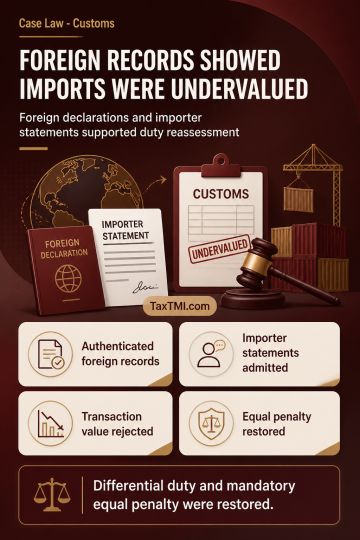
Foreign customs declarations and importer admissions established undervaluation, supporting sequential value redetermination, differential duty, and m...
Customs seizure safeguards prevent detention-based limitation avoidance and invalidate provisional release conditions for imported vehicles under an i...
Page of 4828
Press 'Enter' after typing page number.
361 to 380 of 96556 Results
❮
❯
❯❯
0 / 200
Expand Note
Add to Folder
No Folders have been created
+
Are you sure you want to delete "My most important" ?
An individual's residential status for AY 2020-21 was determined under s.6(1)(c) as the individual exceeded both thresholds (≥365 days in preceding four years and ≥60 days in the relevant year), and the relaxation to 182 days under Explanation 1(a)/(b) was held inapplicable because it is confined to specified cases (leaving India or non-residents "being outside India") and cannot be extended to ordinary visits; accordingly, the individual was held resident in India. Applying Article 4 India-Singapore DTAA, the "permanent home/centre of vital interests" and habitual abode factors showed closer economic ties with India, and nationality also supported India; treaty tie-breaker therefore treated the individual as India resident. Objection to jurisdiction based on s.143(2) notice issuance was rejected due to participation in assessment proceedings. - ITAT
An individual's residential status for AY 2020-21 was determined under s.6(1)(c) as the individual exceeded both thresholds (≥365 days in preceding four years and ≥60 days in the relevant year), and the relaxation to 182 days under Explanation 1(a)/(b) was held inapplicable because it is confined to specified cases (leaving India or non-residents "being outside India") and cannot be extended to ordinary visits; accordingly, the individual was held resident in India. Applying Article 4 India-Singapore DTAA, the "permanent home/centre of vital interests" and habitual abode factors showed closer economic ties with India, and nationality also supported India; treaty tie-breaker therefore treated the individual as India resident. Objection to jurisdiction based on s.143(2) notice issuance was rejected due to participation in assessment proceedings. - ITAT
Note: It is a system-generated summary and is for quick reference only.
 TaxTMI
  TaxTMI
 of 4828

















 Join Channel