TNMM functional comparability requires excluding rice manufacturers from a pure Basmati rice trader's benchmark and recognising operating export recei...
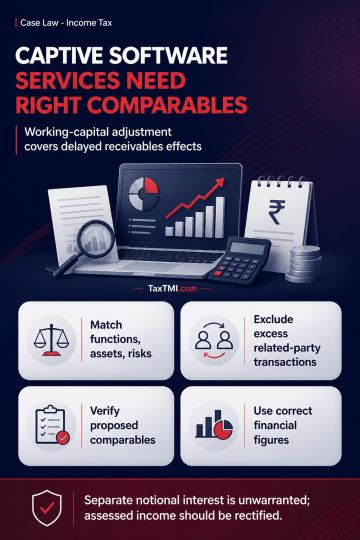
Working-capital adjustment subsumes delayed-receivable effects in TNMM benchmarking of captive software-development services, avoiding separate notion...
Transfer-pricing comparability requires exclusion of financially illogical super-profit comparables and correction of unsupported annual-report and ma...
Charitable character assessment preserves Section 80G approval despite inclusive spiritual teachings and incidental religious expenditure within the s...
Penalty proceedings for cash-loan acceptance require assessment proceedings and recorded Assessing Officer satisfaction; absent these, the proceedings...
Functional comparability governs software-service benchmarking: dissimilar companies are excluded, while related-party filters, margins and working-ca...
The dominant issue was whether an importer could claim customs duty exemption under an earlier notification for import of gold dore bars when the DGFT import licence stated that imports were "subject to" a later notification prescribing duty. The Tribunal held that the licence condition only subjected the import to the later notification and did not bar availing any other applicable exemption; hence, the adjudicating authority's "if and only if" reading was untenable. Relying on the principle that customs authorities cannot deny exemption by questioning an uncancelled DGFT licence, it held duty recovery could arise only if the licence was cancelled by DGFT. Consequently, the duty demand, penalty, and redemption fine were set aside and the appeal was allowed. - CESTAT
The dominant issue was whether an importer could claim customs duty exemption under an earlier notification for import of gold dore bars when the DGFT import licence stated that imports were "subject to" a later notification prescribing duty. The Tribunal held that the licence condition only subjected the import to the later notification and did not bar availing any other applicable exemption; hence, the adjudicating authority's "if and only if" reading was untenable. Relying on the principle that customs authorities cannot deny exemption by questioning an uncancelled DGFT licence, it held duty recovery could arise only if the licence was cancelled by DGFT. Consequently, the duty demand, penalty, and redemption fine were set aside and the appeal was allowed. - CESTAT
Note: It is a system-generated summary and is for quick reference only.
 TaxTMI
  TaxTMI
 of 4830


















 Join Channel


