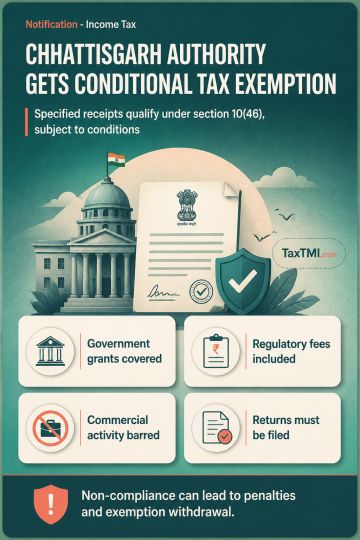
Specified regulatory authority income receives conditional tax exemption, subject to non-commercial activity, unchanged income character, and return f...
Tax exemption for regulatory authority income applies retrospectively, subject to non-commercial activity, unchanged income sources, and return-filing...
Input tax credit conditions remain constitutionally valid, with eligible recipient claims considered under GST circulars and retrospective filing dead...
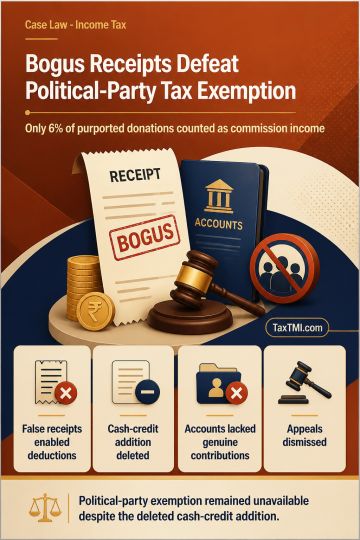
Bogus donation receipts justified commission income assessment and defeated political-party tax exemption for inaccurate accounts and reporting failur...
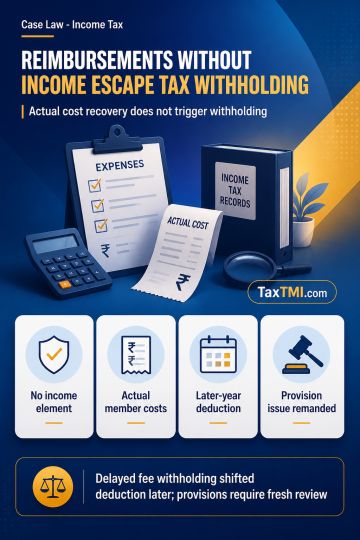
Pure reimbursement without income element escapes tax withholding, while delayed withholding and unsupported provisions face deferred or renewed scrut...
Public benefit requirement defeats charitable registration where residents' association services are reciprocal, member-only facilities governed by mu...
Business loss was disallowed on the premise that it was not genuine; applying s.28, the forum held that real revenue losses incidental to trade are deductible unless expressly barred, and found the disallowance conjectural and contrary to settled law, directing allowance of the loss in full. ESOP cross-charge was treated as notional; relying on prior year orders and the principle that "expenditure" under s.37 includes such employee compensation cost, the deduction for ESOP expense was allowed. Reimbursement of ESOP cost to the parent was held not to be consideration for services and made cost-to-cost; hence no TDS obligation arose under s.195 and the revenue's challenge failed. Manpower expenses were supported by contracts, invoices, statutory records and banking/TDS trail; later non-traceability of a vendor was insufficient absent evidence of cash-back, so the addition was deleted. - ITAT
Business loss was disallowed on the premise that it was not genuine; applying s.28, the forum held that real revenue losses incidental to trade are deductible unless expressly barred, and found the disallowance conjectural and contrary to settled law, directing allowance of the loss in full. ESOP cross-charge was treated as notional; relying on prior year orders and the principle that "expenditure" under s.37 includes such employee compensation cost, the deduction for ESOP expense was allowed. Reimbursement of ESOP cost to the parent was held not to be consideration for services and made cost-to-cost; hence no TDS obligation arose under s.195 and the revenue's challenge failed. Manpower expenses were supported by contracts, invoices, statutory records and banking/TDS trail; later non-traceability of a vendor was insufficient absent evidence of cash-back, so the addition was deleted. - ITAT
Note: It is a system-generated summary and is for quick reference only.
 TaxTMI
 of 4801










 Join Channel


 TaxTMI
