Form 26AS evidence requires successor-entity accounting verification after business transfer, while invoice-supported related-party advertising expend...
Money-laundering judgment timing requires awaiting the scheduled-offence decision despite continuation of the underlying trial where outcomes directly...
Accredited investor eligibility expands through securities-market exposure, while alternative investment fund disputes require prescribed resolution a...
Customs Assessment Portal centralises classification and valuation guidance to support consistent, transparent and informed compliance across stakehol...
Page of 4918
Press 'Enter' after typing page number.
101 to 120 of 98359 Results
❮
❯
❯❯
0 / 200
Expand Note
Add to Folder
No Folders have been created
+
Are you sure you want to delete "My most important" ?
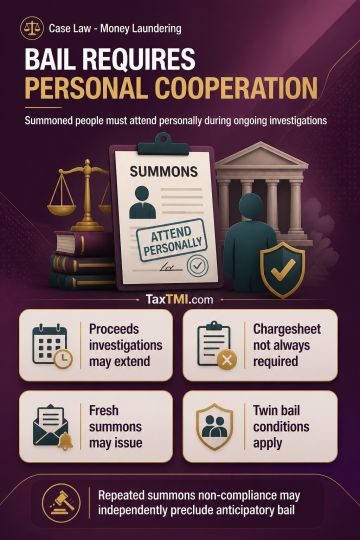
Regular bail under the PMLA was considered on whether continued custody was necessary and proportionate despite Section 45 rigour. The court held that non-issuance of Section 50 summons, though not a statutory precondition to arrest, is a substantive safeguard; its omission, coupled with a largely document/digital investigation with statements and seizures already secured, undercut any demonstrated need for custodial interrogation, making further incarceration disproportionate. The court also treated selective arrest and parity as relevant: similarly or more culpable co-accused were on bail and no distinguishing features were shown to justify unequal treatment. Applying Article 21, bail was granted with stringent conditions. - HC
Regular bail under the PMLA was considered on whether continued custody was necessary and proportionate despite Section 45 rigour. The court held that non-issuance of Section 50 summons, though not a statutory precondition to arrest, is a substantive safeguard; its omission, coupled with a largely document/digital investigation with statements and seizures already secured, undercut any demonstrated need for custodial interrogation, making further incarceration disproportionate. The court also treated selective arrest and parity as relevant: similarly or more culpable co-accused were on bail and no distinguishing features were shown to justify unequal treatment. Applying Article 21, bail was granted with stringent conditions. - HC
Note: It is a system-generated summary and is for quick reference only.
 TaxTMI
  TaxTMI
 of 4918