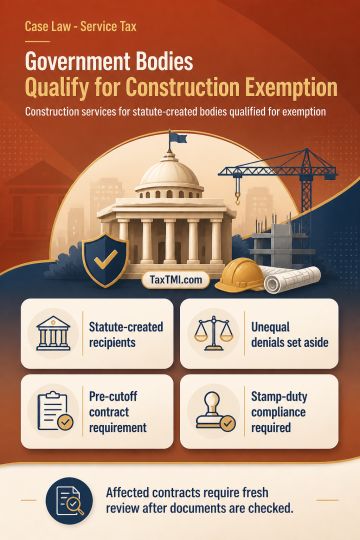
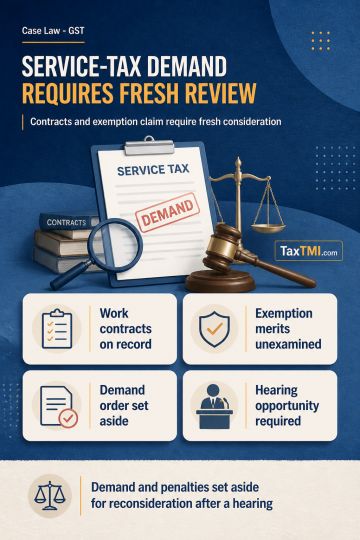
Governmental authority status supports construction-service exemption, while pre-cutoff contract and stamp-duty compliance requires verification on re...
Automated Free Sale and Commerce Certificates enable paperless processing while retaining risk-based manual verification for selected exporter applica...
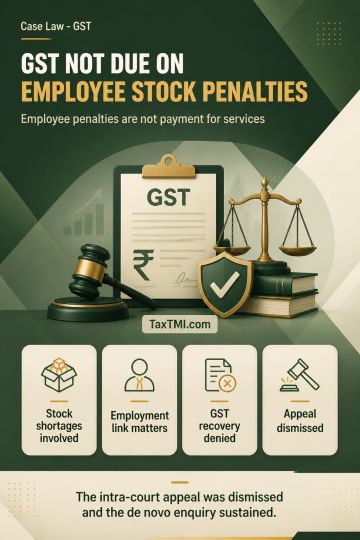
Employee stock-shortage penalties do not constitute consideration for services, preventing GST collection under Schedule II in employment relationship...
The dominant issue was whether an imported implantable intracranial "stent" was classifiable as an "artificial part of the body" under CTI 9021 39 00 or under the residual implanted appliances entry CTI 9021 90 90. Applying the scope of Heading 9021 and the anatomical replacement test, the authority held that the device functions therapeutically as a scaffold to retain embolization coils and achieve occlusion, without replicating or substituting any anatomical vessel or aneurysm wall segment. Since it is not a prosthetic substitute and the competing entries must be compared at the same hierarchical level, classification under "artificial parts" was rejected and the product was classified under CTI 9021 90 90. - AAR
The dominant issue was whether an imported implantable intracranial "stent" was classifiable as an "artificial part of the body" under CTI 9021 39 00 or under the residual implanted appliances entry CTI 9021 90 90. Applying the scope of Heading 9021 and the anatomical replacement test, the authority held that the device functions therapeutically as a scaffold to retain embolization coils and achieve occlusion, without replicating or substituting any anatomical vessel or aneurysm wall segment. Since it is not a prosthetic substitute and the competing entries must be compared at the same hierarchical level, classification under "artificial parts" was rejected and the product was classified under CTI 9021 90 90. - AAR
Note: It is a system-generated summary and is for quick reference only.
 TaxTMI
  TaxTMI
 of 4827











 Join Channel


