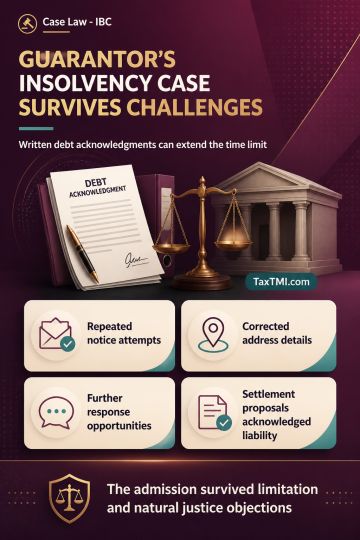
Service of notice and contractual debt acknowledgment preserved insolvency admission against a corporate guarantor despite limitation and natural just...
Original works exemption excludes standalone boulder transportation, leaving subcontracted railway-project transport services subject to service tax l...
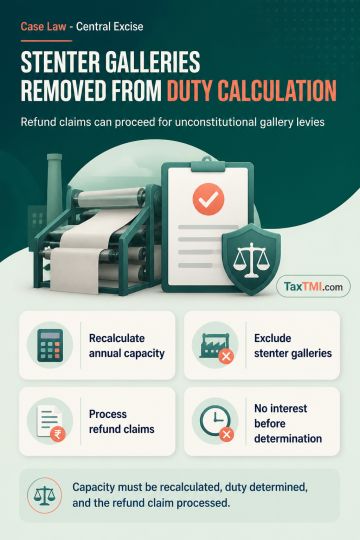
Annual production capacity determinations excluding stenter galleries support refunds for unconstitutional excise levies without an unjust-enrichment ...
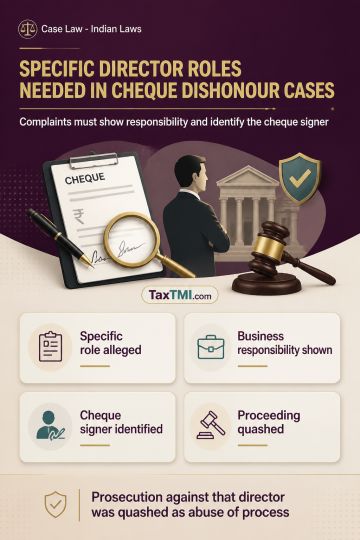
Vicarious liability for cheque dishonour requires specific allegations of responsibility and cheque signatory; generic director allegations cannot sus...
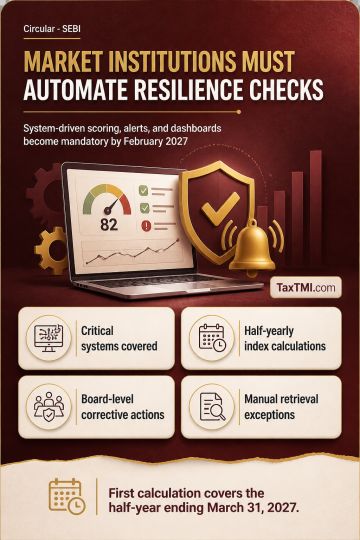
IT Resilience Index requires market infrastructure institutions to automate resilience scoring, early warnings, and continuous service-delivery monito...
The dominant issue was whether advances/deposits written off under "administrative expenses" pursuant to a settlement with an associated party were allowable as revenue deduction under s.37(1) or as business loss under s.28, or were in substance capital outlay for acquisition of an MRI machine. The appellate authority had allowed the claim without examining whether any expenditure or business loss actually arose in the course of business, whether the assessee was in the business of advancing loans, whether there was any attempt to procure the alleged capital asset, and whether the timing and substance of successive agreements supported a genuine business transaction; it also relied on inapplicable precedents and did not consider the binding decision cited by the Revenue. The matter was remanded for fresh adjudication, and the Revenue's appeal was allowed for statistical purposes. - ITAT
The dominant issue was whether advances/deposits written off under "administrative expenses" pursuant to a settlement with an associated party were allowable as revenue deduction under s.37(1) or as business loss under s.28, or were in substance capital outlay for acquisition of an MRI machine. The appellate authority had allowed the claim without examining whether any expenditure or business loss actually arose in the course of business, whether the assessee was in the business of advancing loans, whether there was any attempt to procure the alleged capital asset, and whether the timing and substance of successive agreements supported a genuine business transaction; it also relied on inapplicable precedents and did not consider the binding decision cited by the Revenue. The matter was remanded for fresh adjudication, and the Revenue's appeal was allowed for statistical purposes. - ITAT
Note: It is a system-generated summary and is for quick reference only.
 TaxTMI
  TaxTMI
 of 4828






 Join Channel