Business expenditure deduction requires proof of genuine commission payments and commercial allowability; turnover growth alone cannot validate the cl...
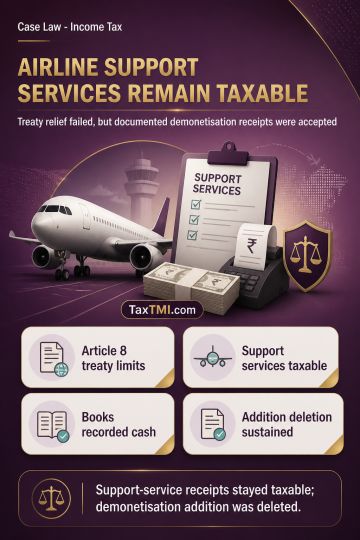
Article 8 treaty coverage excluded third-party airline support services, while documented demonetisation cash receipts remained accepted business inco...
Input tax credit was denied on the ground that returns for May 2018-March 2019 were not filed within the time limit under Section 16(4) of the CGST Act. The Court held that the subsequently introduced Section 16(5) creates an overriding entitlement, since it begins with a non obstante clause and imposes only the condition that the relevant returns be filed on or before 30 November 2021; upon such filing, the limitation under Section 16(4) becomes inapplicable. The earlier adverse order in prior proceedings challenging Section 16(4) did not bar relief, as Section 16(5) furnished a fresh statutory basis. Relief was granted and the petition was disposed of. - HC
Input tax credit was denied on the ground that returns for May 2018-March 2019 were not filed within the time limit under Section 16(4) of the CGST Act. The Court held that the subsequently introduced Section 16(5) creates an overriding entitlement, since it begins with a non obstante clause and imposes only the condition that the relevant returns be filed on or before 30 November 2021; upon such filing, the limitation under Section 16(4) becomes inapplicable. The earlier adverse order in prior proceedings challenging Section 16(4) did not bar relief, as Section 16(5) furnished a fresh statutory basis. Relief was granted and the petition was disposed of. - HC
Note: It is a system-generated summary and is for quick reference only.
 TaxTMI
 of 4782












 Join Channel


 TaxTMI