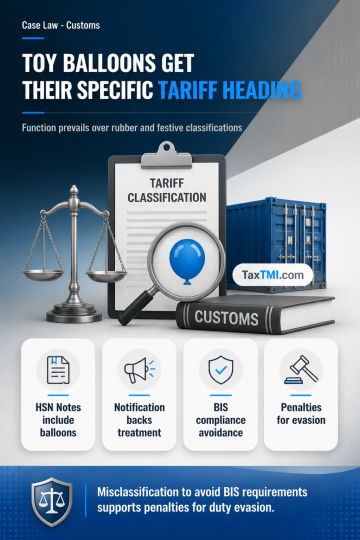
Toy balloon tariff classification: functional heading prevails over residual rubber and festive article headings, supporting penalties for deliberate ...
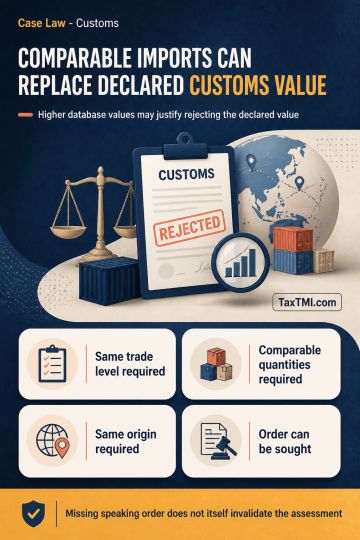
Customs valuation using comparable contemporaneous imports can displace declared value, while missing speaking orders require pursuit before competent...
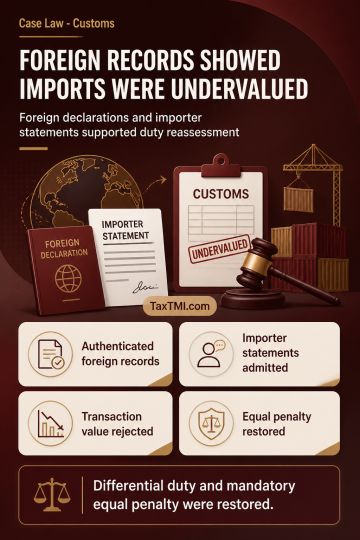
Foreign customs declarations and importer admissions established undervaluation, supporting sequential value redetermination, differential duty, and m...
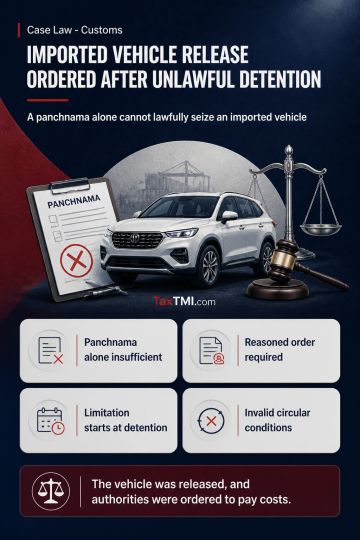
Customs seizure safeguards prevent detention-based limitation avoidance and invalidate provisional release conditions for imported vehicles under an i...
Page of 4828
Press 'Enter' after typing page number.
361 to 380 of 96556 Results
❮
❯
❯❯
0 / 200
Expand Note
Add to Folder
No Folders have been created
+
Are you sure you want to delete "My most important" ?
AAR held that the applicant is not entitled to preferential customs duty under APTA for imports involving third-party invoicing. It found that the APTA Rules of Origin (Rules 2-6, 8) require originating status, direct consignment, and a valid Certificate of Origin, but contain no substantive provision authorizing third-country invoicing or third-country trade. The reference to "third-party trade" in the Certificate of Origin completion notes and administrative Instruction No. 23/2024 was treated as merely procedural and incapable of enlarging treaty-based benefits. Applying strict construction of taxing statutes, AAR ruled that, absent explicit treaty authorization, third-party invoicing cannot support APTA preferential duty.
AAR held that the applicant is not entitled to preferential customs duty under APTA for imports involving third-party invoicing. It found that the APTA Rules of Origin (Rules 2-6, 8) require originating status, direct consignment, and a valid Certificate of Origin, but contain no substantive provision authorizing third-country invoicing or third-country trade. The reference to "third-party trade" in the Certificate of Origin completion notes and administrative Instruction No. 23/2024 was treated as merely procedural and incapable of enlarging treaty-based benefits. Applying strict construction of taxing statutes, AAR ruled that, absent explicit treaty authorization, third-party invoicing cannot support APTA preferential duty.
Note: It is a system-generated summary and is for quick reference only.
 TaxTMI
  TaxTMI
 of 4828










 Join Channel