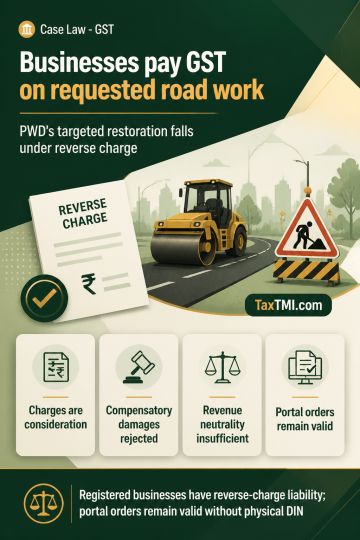
Request-driven road restoration attracts reverse-charge GST, not governmental-function treatment or compensatory-damages status for business recipient...
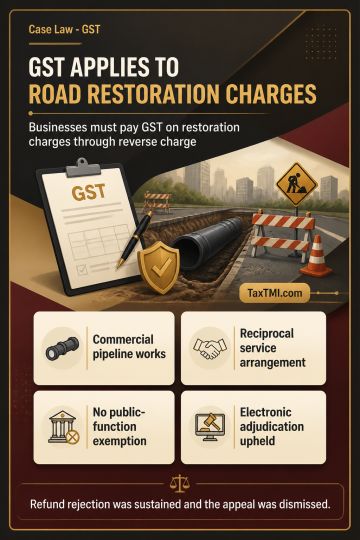
Road restoration charges for commercial pipeline works are taxable Government services, with reverse charge liability and no public-function exemption...
Model-wise import cap monitoring cannot justify withholding used multifunction machines where all-India tracking is absent and full security is furnis...
SC held that the sole arbitrator's mandate had automatically terminated on expiry of the statutory period under Section 29A(1) of the Arbitration and Conciliation Act, 1996, after exclusion of the Covid-19 period. As no application for extension was made before expiry, the arbitrator became functus officio and could not continue. SC ruled that the HC erred in merely extending the mandate instead of substituting the arbitrator under Section 29A(6). The impugned HC order was quashed, the existing arbitrator's mandate was declared terminated by operation of law, and a former HC judge was appointed as substituted sole arbitrator, directed to conclude proceedings within six months. Appeal allowed.
SC held that the sole arbitrator's mandate had automatically terminated on expiry of the statutory period under Section 29A(1) of the Arbitration and Conciliation Act, 1996, after exclusion of the Covid-19 period. As no application for extension was made before expiry, the arbitrator became functus officio and could not continue. SC ruled that the HC erred in merely extending the mandate instead of substituting the arbitrator under Section 29A(6). The impugned HC order was quashed, the existing arbitrator's mandate was declared terminated by operation of law, and a former HC judge was appointed as substituted sole arbitrator, directed to conclude proceedings within six months. Appeal allowed.
Note: It is a system-generated summary and is for quick reference only.
 TaxTMI
  TaxTMI
 of 4918