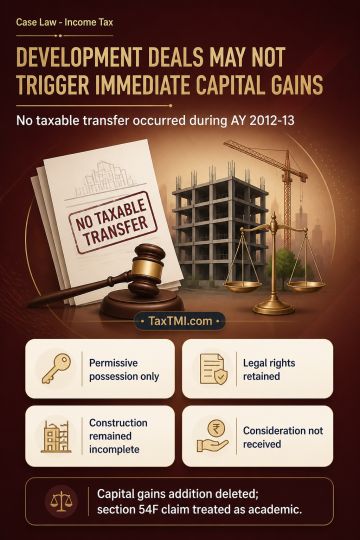
Development agreements require legal possession or effective enjoyment for capital gains transfer; permissive possession and deferred consideration de...
Prolonged sterilisation of development rights supports capital-gains treatment, while business-income disallowances cannot govern capital-gains comput...
Additional evidence in transfer pricing dispute leads to fresh examination, while tax deductions, TDS credit, fee and refund interest require verifica...
Category II AIF pass-through taxation preserves non-business income character; investment receipts cannot be reclassified without applying recognised ...
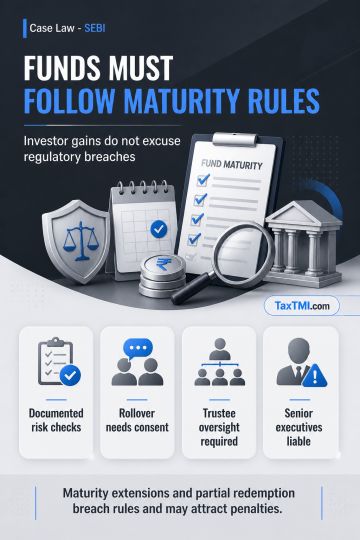
Mutual fund maturity rules require proper rollover, redemption, disclosure, and due diligence; investor gains cannot excuse regulatory breaches or pen...
HC dismissed the writ petition challenging the SCN issued by Central GST authorities. It held that the applicability of Section 6 of the CGST Act, the interplay between State and Central proceedings, the effect of earlier State GST orders (including audit orders), and the petitioner's precise status as a "government authority" are all contentious factual and legal issues requiring adjudication by the competent authority. The SCN could not be termed "wholly without jurisdiction" at the threshold. Relying on the SC's jurisprudence on alternative remedies, the HC declined to exercise its writ jurisdiction under Article 226 and left all contentions open to be urged before the adjudicating authority.
HC dismissed the writ petition challenging the SCN issued by Central GST authorities. It held that the applicability of Section 6 of the CGST Act, the interplay between State and Central proceedings, the effect of earlier State GST orders (including audit orders), and the petitioner's precise status as a "government authority" are all contentious factual and legal issues requiring adjudication by the competent authority. The SCN could not be termed "wholly without jurisdiction" at the threshold. Relying on the SC's jurisprudence on alternative remedies, the HC declined to exercise its writ jurisdiction under Article 226 and left all contentions open to be urged before the adjudicating authority.
Note: It is a system-generated summary and is for quick reference only.
 TaxTMI
 of 4794















 Join Channel


 TaxTMI
