Clean slate principle extinguishes uncrystallised operational claims and bars continuation of pending recovery and arbitral proceedings after plan app...
Works contract classification governs composite layout-development contracts where VAT-paid goods are transferred alongside construction and infrastru...
Specified income tax exemption for pollution control body remains conditional on non-commercial activity, unchanged income character, and return filin...
Jurisdictional facts in certificate-of-origin discrepancies can support customs show-cause proceedings, leaving factual explanations for departmental ...
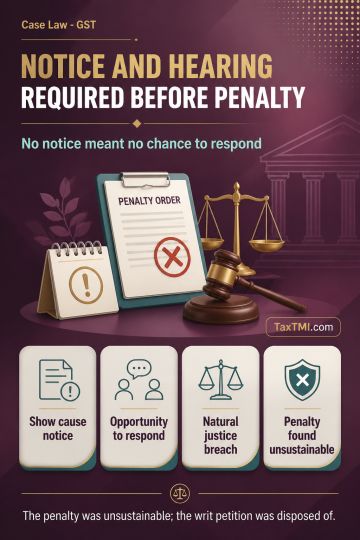
The HC held that the impugned assessment order confirming tax demand of Rs. 6,93,77,821/-, in excess of the sum of Rs. 2,49,63,816/- proposed in the show-cause notice, was contrary to s.75(7) KGST Act and violative of principles of natural justice. It observed that the authority could not travel beyond the quantification in the SCN and that the rectification application was wrongly rejected on jurisdictional grounds. Consequently, the HC set aside the impugned order-in-original and the consequential order (Annexures-A and A1) and remanded the matter to the jurisdictional authority (R-3) for fresh consideration and reassessment strictly in accordance with law, after affording due opportunity of hearing to the petitioner. The petition was allowed by way of remand.
The HC held that the impugned assessment order confirming tax demand of Rs. 6,93,77,821/-, in excess of the sum of Rs. 2,49,63,816/- proposed in the show-cause notice, was contrary to s.75(7) KGST Act and violative of principles of natural justice. It observed that the authority could not travel beyond the quantification in the SCN and that the rectification application was wrongly rejected on jurisdictional grounds. Consequently, the HC set aside the impugned order-in-original and the consequential order (Annexures-A and A1) and remanded the matter to the jurisdictional authority (R-3) for fresh consideration and reassessment strictly in accordance with law, after affording due opportunity of hearing to the petitioner. The petition was allowed by way of remand.
Note: It is a system-generated summary and is for quick reference only.
 TaxTMI
 of 4792
















 Join Channel


 TaxTMI