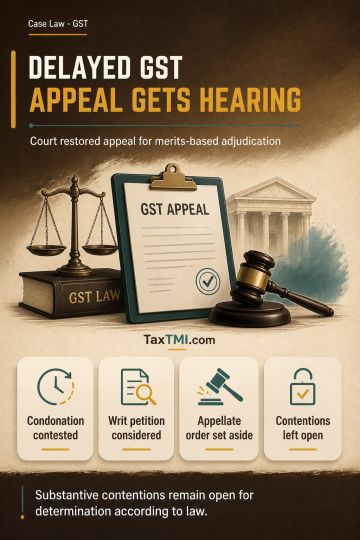
Necessary-party requirements limit impleadment of independent entities, while deferred consideration does not create an appealable adverse determinati...
Food supplement classification requires common parlance and authoritative tests, preventing treatment as proprietary Ayurvedic medicines without suppo...
Specified regulatory authority income receives conditional tax exemption, subject to non-commercial activity, unchanged income character, and return f...
Tax exemption for regulatory authority income applies retrospectively, subject to non-commercial activity, unchanged income sources, and return-filing...
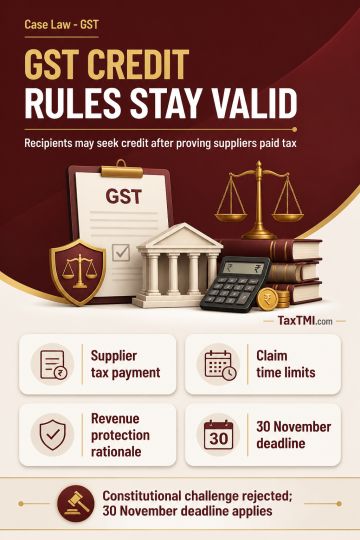
Input tax credit conditions remain constitutionally valid, with eligible recipient claims considered under GST circulars and retrospective filing dead...
ITAT held that, under S.32 read with S.43(6)(c) and Rule 5, depreciation is governed by the "block of assets" concept and the individual identity of a depreciable asset is extinguished once it forms part of the block. In the case of Assessee X, the motor car was part of the "Motor Cars" block (15%), and the sale consideration of Rs. 5,60,000 had already been reduced from the block while computing depreciation in the return. ITAT held that no separate taxable profit arises on sale of an individual asset within the block and that taxing the book profit of Rs. 4,83,894 amounted to impermissible double taxation. As the AO cited no enabling provision and CIT(A) gave no cogent reasoning, the addition was deleted. Appeal allowed in favour of Assessee X.
ITAT held that, under S.32 read with S.43(6)(c) and Rule 5, depreciation is governed by the "block of assets" concept and the individual identity of a depreciable asset is extinguished once it forms part of the block. In the case of Assessee X, the motor car was part of the "Motor Cars" block (15%), and the sale consideration of Rs. 5,60,000 had already been reduced from the block while computing depreciation in the return. ITAT held that no separate taxable profit arises on sale of an individual asset within the block and that taxing the book profit of Rs. 4,83,894 amounted to impermissible double taxation. As the AO cited no enabling provision and CIT(A) gave no cogent reasoning, the addition was deleted. Appeal allowed in favour of Assessee X.
Note: It is a system-generated summary and is for quick reference only.
 TaxTMI
 of 4792















 Join Channel


 TaxTMI