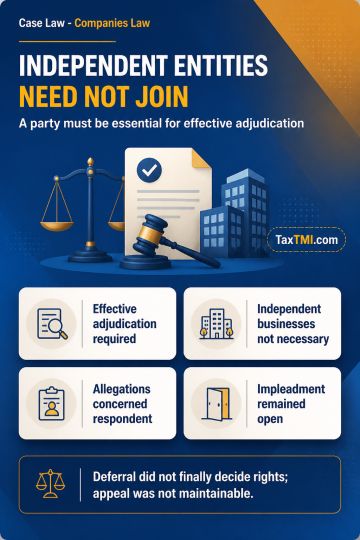
Necessary-party requirements limit impleadment of independent entities, while deferred consideration does not create an appealable adverse determinati...
Food supplement classification requires common parlance and authoritative tests, preventing treatment as proprietary Ayurvedic medicines without suppo...
Specified regulatory authority income receives conditional tax exemption, subject to non-commercial activity, unchanged income character, and return f...
Tax exemption for regulatory authority income applies retrospectively, subject to non-commercial activity, unchanged income sources, and return-filing...
Input tax credit conditions remain constitutionally valid, with eligible recipient claims considered under GST circulars and retrospective filing dead...
Page of 4790
Press 'Enter' after typing page number.
481 to 500 of 95794 Results
❮
❯
❯❯
0 / 200
Expand Note
Add to Folder
No Folders have been created
+
Are you sure you want to delete "My most important" ?
NCLAT considered company appeals challenging an order dismissing contempt proceedings arising from an interlocutory order passed under the I&B Code. The Appellate Tribunal held that, under Section 19 of the Contempt of Courts Act, 1971, an appeal lies only from an order or decision of a High Court "to punish for contempt," i.e., an order imposing punishment under Section 12, and not from a mere dismissal of a contempt petition. As the impugned order only rejected the contempt petition without awarding any punishment, it did not qualify as an appealable order under Section 19. NCLAT further noted that the I&B Code does not incorporate the Contempt of Courts Act by reference. Consequently, the company appeals filed by the anonymized appellants against dismissal of contempt were held not maintainable and were dismissed.
NCLAT considered company appeals challenging an order dismissing contempt proceedings arising from an interlocutory order passed under the I&B Code. The Appellate Tribunal held that, under Section 19 of the Contempt of Courts Act, 1971, an appeal lies only from an order or decision of a High Court "to punish for contempt," i.e., an order imposing punishment under Section 12, and not from a mere dismissal of a contempt petition. As the impugned order only rejected the contempt petition without awarding any punishment, it did not qualify as an appealable order under Section 19. NCLAT further noted that the I&B Code does not incorporate the Contempt of Courts Act by reference. Consequently, the company appeals filed by the anonymized appellants against dismissal of contempt were held not maintainable and were dismissed.
Note: It is a system-generated summary and is for quick reference only.
 TaxTMI
 of 4790
















 Join Channel


 TaxTMI

